
Quick Answer
For many precision, cosmetic, and contamination-sensitive components, dustless blasting is often a better fit than dry blasting because it uses water and abrasive media together to suppress airborne dust, soften impact peaks, and produce a more uniform finish. In industrial surface treatment, it is especially useful for fine deburring, edge preparation, coating pretreatment, AM post-processing, and glass frosting. It is not always the fastest method for heavy stock removal, but it is frequently the more controllable option when finish consistency, lower mess, and repeatable process behavior matter most.
| Core factor | Typical conclusion |
|---|---|
| Process type | Wet abrasive blasting using a water-abrasive slurry and compressed air |
| Operating range | Typically low to medium blasting intensity, adjusted by substrate and finish target |
| Finish outcome | Fine, even matte or satin surface with controlled micro-erosion |
| Dust behavior | Strongly reduced airborne dust compared with dry blasting |
| Main use cases | Deburring, edge honing, coating pretreatment, AM cleanup, cosmetic finishing |
| Lead-time profile | Typical lead time is shorter for standard cabinets and longer for customized automated systems |
What Is dustless blasting
Dustless blasting is an abrasive surface treatment method in which blasting media are suspended in water and then directed at a workpiece with compressed air or a comparable acceleration system. In industrial practice, the term is commonly used for wet blasting, slurry blasting, or vapor-style blasting processes that reduce airborne dust by keeping the abrasive stream in a water phase. It belongs to the broader family of abrasive blasting processes, but it behaves differently from a dry abrasive stream in both finish formation and environmental control.
The technical distinction is important. In dry blasting, media strike the surface in a relatively unbuffered air stream. In dustless blasting, water acts as both carrier and cushion, changing particle impact behavior and reducing the free dust that would otherwise disperse around the cabinet or production cell. That difference is why buyers often consider dustless blasting for parts that need more controlled surface conditioning rather than simply aggressive stripping.
Within the wider wet blasting family, dustless blasting can cover several process goals. It may be used to remove burrs from machined parts, round or stabilize cutting edges, clean scale from forgings, prepare metal before coating, frost glass, or smooth the surfaces of additively manufactured components. The common thread is not the part geometry but the need for a controlled abrasive action with less airborne contamination.
One of the main reasons the process is selected is dust suppression. Because the abrasive is carried in water, a large portion of the particulate matter that would become airborne in dry blasting remains captured in the slurry loop. That changes not only operator visibility and housekeeping, but also enclosure design, waste handling, and downstream cleanliness requirements.
A second advantage is lower risk of media embedding on many sensitive substrates. In some dry processes, sharp particles can be driven into softer or coated surfaces, especially when aggressive settings are used. In a dustless blasting process, the water film can reduce that tendency and support a finer surface appearance on visually critical parts.
A third advantage is finish uniformity. Because the slurry cushions impact and distributes media in a more moderated stream, the process often creates smoother, more even textures than comparable dry blasting setups. That matters for tool preparation, decorative glass, electronics housings, and other applications where appearance and tactile consistency are part of the specification.
Finally, the method is well suited to process repeatability when pressure, slurry concentration, nozzle position, and recirculation quality are controlled. In many factories, the real value of dustless blasting is not simply that it is cleaner, but that it can keep surface treatment results within a narrower operating window from batch to batch.
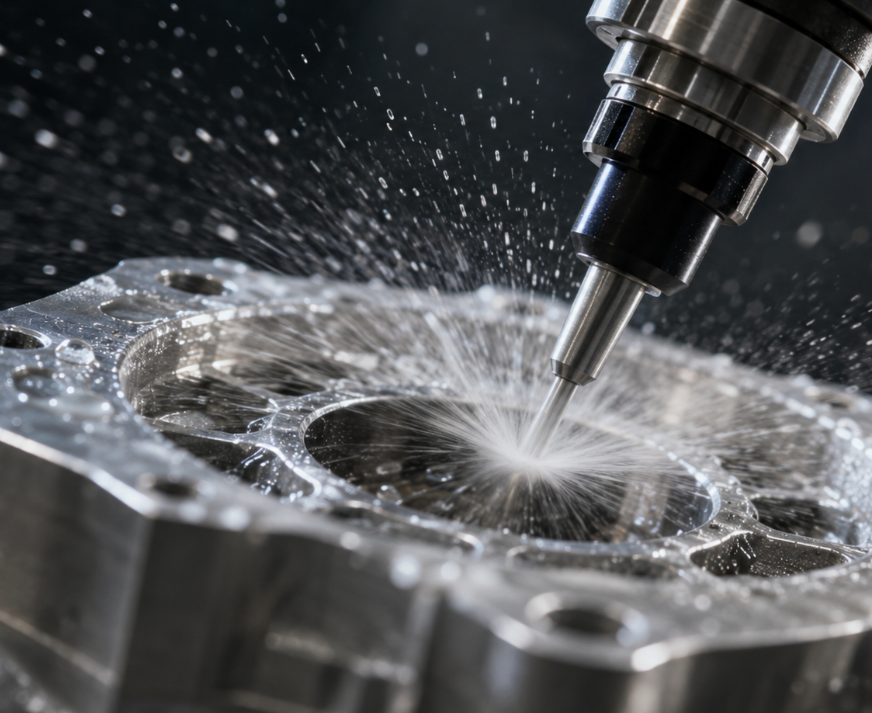
How Does dustless blasting Work
Dustless blasting works through a coordinated system of slurry preparation, air-driven acceleration, controlled nozzle exposure, and closed-loop recovery. From the outside, it may look like a simple cabinet process, but the final surface quality depends on how consistently each part of the system performs over time.
Slurry preparation in wet blasting systems
The process begins in a slurry tank or circulation chamber where water and abrasive media are mixed into a suspension. Agitation, pumping, or constant recirculation helps prevent settling, because an unstable slurry leads directly to unstable blasting intensity. If the solids concentration drifts during production, identical pressure settings can yield visibly different finishes on consecutive parts.
Media grade is selected according to the workpiece material, required roughness, burr size, target edge condition, and acceptable running cost. Fine media are typically used for edge honing, frosting, and cosmetic refinement, while coarser grades may be chosen for faster cleaning or scale removal. The water-to-media ratio is equally important, because the slurry must carry enough abrasive to cut efficiently without becoming too dense to circulate consistently.
Compressed air acceleration path
Once the slurry is conditioned, compressed air accelerates it through hoses and nozzles toward the workpiece. The nozzle converts flow and pressure into a defined blast pattern, and that pattern determines local removal rate, finish uniformity, and sensitivity to standoff distance. Nozzle wear gradually changes the delivered stream, so a production recipe is only as reliable as the maintenance discipline behind it.
Because the media travel in water rather than as a dry particle cloud, the impact profile is moderated. This is one reason dustless blasting is often chosen when the objective is selective deburring or cosmetic consistency instead of maximum aggressiveness. The water phase can dampen peak impact and help create a finer matte finish across exposed surfaces.
Closed-loop slurry recovery and sedimentation
After the abrasive strikes the workpiece, the slurry drains into the recovery zone of the machine. Usable water and media are recirculated, while fractured particles, fines, and removed contamination are separated through sedimentation and waste discharge steps. In a properly designed system, this closed-loop approach reduces consumable loss and supports more stable blasting behavior during long shifts.
Dustless blasting does not eliminate waste management; it changes its form. Instead of handling mainly dry dust, the operator manages mist, contaminated slurry, and settled waste. That is why drainage design, sludge discharge, and water-mist control are important engineering factors in any industrial wet blasting installation.
Dust collection and water-mist control
Although the process sharply reduces free dust, it can still generate atomized moisture and suspended fines inside the enclosure. Cabinet visibility and operator comfort depend on mist extraction, internal airflow management, and separation efficiency. Where the blasting step is part of a coating-preparation route, users often assess cleanliness practice within broader surface preparation guidance from AMPP rather than viewing blasting as a standalone step.
PID pressure control and recipe stability
A stable process depends on more than a regulator setting. Slurry density, hose routing, pump condition, nozzle wear, and recirculation load can all affect the energy that actually reaches the part. For that reason, better systems use closed-loop control logic to hold the target blasting condition more steadily during production.
Where automation is required, nozzle path accuracy becomes just as important as pressure control. Standoff distance, dwell time, angle of attack, and traverse speed all influence edge radius, burr removal depth, and visible texture. In the DassiAuto equipment context, servo X/Y/Z linkage is specified at 0.02 mm servo accuracy, a relevant figure for process paths that must be repeated across multiple part families rather than adjusted manually every cycle.
In production dustless blasting, the most important variable is often not peak pressure but stability of delivered energy over time.
| Parameter | Typical dustless blasting range or note | Why it matters |
|---|---|---|
| Working pressure | Typically low to medium blasting pressure, selected by substrate and finish target | Governs impact energy, cut rate, and risk of overprocessing |
| Slurry concentration | Typically adjusted by weight percentage or volume ratio based on media and application | Influences finish consistency and removal efficiency |
| Abrasive particle size | Commonly fine to medium grades for honing, deburring, cleaning, or frosting | Affects roughness, edge conditioning, and visual texture |
| Air flow demand | Depends on nozzle diameter, pressure, and duty cycle | Determines acceleration stability and plant utility load |
| Nozzle standoff | Typically held within a validated process window | Strongly influences spot size, dwell intensity, and repeatability |
| Media consumption | Varies with breakdown rate, contamination, and recovery efficiency | Drives consumable cost and maintenance planning |
| Control method | Manual setting or PLC/HMI recipe management | Determines repeatability and operator dependence |
| Recovery loop | Recirculation with sedimentation, discharge, and mist control | Supports uptime, cleanliness, and stable slurry quality |
dustless blasting vs Dry Blasting vs Other Methods
Dustless blasting should be compared with alternatives according to the function of the surface, not just the equipment category. Dry blasting, shot peening, and vibratory finishing each have valid industrial roles, but they optimize different outcomes.
Dry blasting is often preferred for aggressive cleaning, rust stripping, or high-rate profile generation where finish delicacy is secondary. Shot peening is different again because its core purpose is to introduce compressive residual stress for fatigue benefit rather than to create a cosmetic or deburred finish; that distinction is reflected in general shot peening reference terminology. Vibratory finishing, by contrast, is well suited to bulk processing of small parts, but it offers less local selectivity and can be difficult to control on hidden features or feature-specific edges.
| Evaluation factor | dustless blasting | Dry blasting | Shot peening | Vibratory finishing |
|---|---|---|---|---|
| Airborne dust | Low, because water suppresses most free dust | High unless fully enclosed and strongly extracted | Moderate, depending on enclosure and media system | Low external dust, but slurry or compound waste may be significant |
| Surface finish | Fine, even matte or satin finish | More aggressive texture and often rougher visual appearance | Peened texture intended for stress benefit, not cosmetic uniformity | Smoothed mass-finished surface |
| Media embedding risk | Generally lower on many sensitive surfaces | Higher on some soft or coated substrates | Evaluated differently because impact intent is stress conditioning | Not a blasting process |
| Precision control | High with fixturing, recipe control, and servo motion | Moderate to high, but often harsher on delicate features | Coverage-focused rather than appearance-focused | Lower for local feature treatment |
| Deburring suitability | Good for fine burrs and controlled edge work | Good for heavier burrs, but with greater risk of surface overattack | Not primarily intended for deburring | Good for bulk small-part deburring |
| Environmental handling | Lower dust burden, but slurry and sediment must be managed | High dust collection and cleanup burden | Enclosed media-management burden | Wastewater and compound handling burden |
| Best-fit use | Precision finishing, coating prep, edge prep, AM cleanup | Heavy cleaning, oxide removal, rapid roughening | Fatigue-related surface conditioning | Bulk finishing of simpler part families |
For procurement teams, the practical conclusion is usually straightforward. If the part is geometry-sensitive, finish-sensitive, or cleanliness-sensitive, dustless blasting often compares favorably. If the part carries thick rust, heavy scale, or needs very fast stripping with little concern for micro-finish control, dry blasting may still be the stronger option.
Key Specifications to Evaluate Before Buying
A dustless blasting machine should be evaluated as a process platform, not just as a cabinet with a pressure rating. Buyers who focus only on chamber size or maximum pressure often miss the variables that actually determine finish consistency, operating cost, and long-term reliability.
Pressure range and delivered-pressure stability
Ask for the usable pressure window, not just the maximum rating. For precision work, stable delivered pressure matters more than a high headline number, especially when edge radius, burr removal depth, or visual texture must remain within a narrow tolerance band.
Slurry circulation quality
The machine should keep abrasive evenly suspended during continuous production. Key questions include how the slurry is agitated, how solids settling is prevented, how concentration is monitored, and how easily the operator can restore a validated media-water balance after cleaning or maintenance.
Motion control and path accuracy
If the process includes selective blasting, edge preparation, or complex geometries, motion capability becomes central to quality. Review whether the machine uses manual manipulation, fixed fixtures, programmable servo axes, or robot-assisted handling, and confirm whether path control is repeatable enough for the most demanding part family.
Throughput and cycle structure
Published cycle time can be misleading if it excludes loading, unloading, rinsing, drainage, sludge discharge, or part changeover. A realistic assessment should separate blasting time from total station time and should evaluate output at the approved quality level rather than at an optimistic demonstration condition.
Workspace, footprint, and utilities
The installed footprint includes more than the cabinet shell. Compressed air supply, electrical service, water circulation hardware, sludge handling, maintenance clearance, and mist extraction all consume plant space and should be planned together. Large panels, rods, or awkward forgings may also require special attention to loading method and ergonomic access.
HMI, recipe control, and permission management
For multi-part production, the control interface is a quality tool. Recipe storage, alarm history, parameter locking, and hierarchical user permissions reduce the risk that an approved process will drift because operators manually reset key variables at the machine.
Waste-sand and maintenance strategy
Dustless blasting reduces housekeeping dust but shifts the burden toward wet waste and recirculation maintenance. Buyers should examine sedimentation design, discharge convenience, pump access, nozzle replacement intervals, viewing-window protection, and the time needed for routine cleanout between media changes.
Safety and compliance review
Safety assessment should include electrical protection in wet environments, door interlocks, enclosure sealing, safe service access, and visibility during blasting. If the process is part of a pretreatment route before painting or bonding, it is also sensible to align evaluation criteria with recognized manufacturing and coating-cleanliness practices rather than relying on appearance alone.
Applications Across Industries
Dustless blasting is used across multiple industrial sectors because the same underlying process can be tuned for cosmetic finishing, functional preparation, or controlled material removal. The actual application range is much broader than simple cleaning, and the process window changes significantly with substrate, geometry, and downstream requirements.
In carbide tooling, the emphasis is on edge condition and coating readiness rather than bulk removal speed. Process routes centered on cutting-tool edge honing typically focus on K-factor control, cutting-edge stability, and consistent pre-coating surface condition.
In general metalworking, the process is often chosen for fine deburring where tumbling is too indiscriminate and manual finishing is too variable. Workflows built around metal-part burr removal are usually aimed at knocking down small burrs while preserving part geometry and maintaining a predictable visual finish.
Pretreatment lines use dustless blasting differently. There, the process contributes to cleaning and surface conditioning before paint, phosphating, or other downstream layers, which is why many engineers evaluate it within the logic of coating pretreatment wet blasting rather than as a standalone blast step.
| Application | Industry served | Typical workpiece | Main process benefit |
|---|---|---|---|
| Edge honing | Carbide cutting tools | Inserts, drills, end mills | Stable edge preparation and improved coating readiness |
| Burr removing | Precision metalworking | Stamped, machined, and sintered metal parts | Selective burr reduction with controlled surface effect |
| Scale removal | Forging and steel processing | Bars, forgings, heat-treated parts | Cleaner surfaces with lower airborne dust than dry methods |
| Coating pretreatment | Painting and protective coatings | Steel and aluminum fabricated parts | Uniform cleaning and better downstream adhesion consistency |
| AM post-processing | Additive manufacturing | Metal 3D-printed components | Powder residue cleanup and smoothing of complex features |
| Peening and conditioning | Metal component finishing | Springs, formed parts, selected fatigue-sensitive parts | Controlled surface conditioning before later operations |
| Glass frosting | Glass processing | Decorative panels and technical glass | Even matte translucency and visual uniformity |
| 3C device finishing | Electronics supply chain | Frames, covers, housings | Consistent cosmetic texture and improved touch feel |
One reason the process spans so many sectors is that abrasive, concentration, nozzle path, and exposure time can all be tuned independently. The same dustless blasting principle can therefore support a carbide insert, a forged steel part, a glass panel, or an additively manufactured lattice component, provided the equipment and recipe are matched to the application.
Equipment Selection Guide
Machine selection is easiest when buyers sort part families by production scale, geometry, required precision, and changeover frequency. That approach avoids a common mistake: comparing a flexible R&D cell, a standard batch cabinet, and a semi-automated production machine as though they are alternatives for the same operating scenario.
| Configuration or model tier | Target production scale | Workpiece size range | Precision level | Recommended applications |
|---|---|---|---|---|
| R&D robot-assisted cell | Sample testing and process development | Small to medium mixed parts | High | Trials, application validation, frequent changeover |
| Manual technical cabinet | Low-volume specialist work | Small parts | Medium to high | Feasibility runs, rework, process screening |
| Standard single-chamber batch cabinet | Routine batch production | Small to medium parts | Medium | General deburring, cleaning, and edge preparation |
| Single-piece dedicated machine | Repetitive single-part processing | One part or one fixture at a time | Medium to high | Controlled finish on individual workpieces |
| Double-chamber production system | Higher-throughput production | Small to medium parts | Medium | Alternating load/unload flow with reduced idle time |
| Servo multi-axis complex-part system | Precision production of shaped parts | Complex 3D components | High | Multi-face finishing and geometry-sensitive treatment |
| Large-workspace plate-part machine | Medium to large flat workpieces | Plate-shaped or wide parts | Medium | Panel pretreatment and broad-surface finishing |
| Round-rod processing line | Continuous long-part treatment | Rods, shafts, bar stock | Medium | Scale removal and cylindrical surface conditioning |
For application development and small-lot testing, an R&D-oriented configuration such as the RB-6 robot-assisted wet blasting unit fits frequent parameter changes, sample validation, and fixture experimentation. For steady batch production, a more conventional chamber such as the SC-40 single-chamber blasting cabinet is typically better aligned with routine loading rhythm and day-to-day process repeatability.
Where throughput drives the business case, chamber utilization becomes more important than simple nozzle power. A system such as the DC-40 double-chamber production machine is relevant when alternating load and blast cycles can reduce operator waiting time and improve practical hourly output.
Cost, Lead Time and ROI Considerations
The cost of a dustless blasting system is shaped more by configuration depth than by cabinet size alone. A basic manual or semi-manual machine may be relatively straightforward, while servo axes, robotic handling, recipe control, traceability, or integrated pretreatment functions can significantly change the final package.
Automation level is one of the clearest cost drivers. Manual blasting may involve lower initial investment, but it often brings more operator dependence and more variation in standoff distance, angle, and dwell time. Automated motion and recipe control add complexity, yet they can reduce variation-related scrap and lower the burden of operator skill transfer across shifts.
The abrasive system also affects both capital and operating cost. Slurry recirculation design, sediment discharge method, mist extraction, nozzle wear behavior, and media contamination control all influence the long-term ownership profile. A lower-priced system can become more expensive over time if it requires frequent cleanout, unstable media concentration recovery, or excessive consumable replacement.
Lead time should always be treated as typical rather than guaranteed. Standardized cabinet models generally move faster than customized multi-axis cells or integrated surface-preparation lines, because the latter require more engineering, fixture development, acceptance testing, and installation planning. Sample approval and design freeze frequently add meaningful time before fabrication even begins.
ROI analysis should remain structural and evidence-based. Common value levers include reduced manual deburring labor, better coating adhesion consistency, lower rework on cosmetic surfaces, longer tool life after precise edge preparation, and less uncontrolled dust cleanup than a comparable dry-blast operation. In many factories, the true economic gain comes from reducing variation rather than merely reducing labor minutes.
A disciplined calculation should focus on cost per acceptable part. That means including labor, utilities, abrasive consumption, nozzle wear, maintenance downtime, sludge handling, scrap, and rework in the same model. Plants that use formal measurement discipline often frame these decisions in line with broader NIST manufacturing measurement guidance, because repeatable surface treatment depends on repeatable process control.
Why Choose DassiAuto — Our Company
DassiAuto Intelligent Equipment Co., Ltd is a Chinese manufacturer established in 2012 and focused on wet blasting technology for industrial surface treatment. According to the company context, it is a national high-tech enterprise operating under the ISO 9001 quality management standard, with a portfolio of invention patents, utility model patents, and software copyrights related to blasting equipment and control systems. Its stated scope covers planning, design, manufacturing, sales, and application development across the surface-treatment value chain. The engineering features described across its lineup include PID closed-loop slurry pressure control, servo-driven X/Y/Z linkage with 0.02 mm accuracy, HMI recipe management with hierarchical permissions, automatic waste-sand sedimentation with one-click discharge, and dust-collection systems that reduce water mist. The company context also lists eight equipment configurations spanning R&D, batch production, and application-specific process needs, along with customer references including Wecan Cutting Tools, Ruian Carbide Tools, Huareal, Metcera, OKE, YG, Kelite, and XTC. Its service model runs from sample testing to after-sales, covering application development, planning, manufacturing, installation, commissioning, training, spare parts, abrasive resupply, and process optimization. Company background and certification details are summarized on the company profile page.
FAQ
Q1. Can dustless blasting equipment be tested on sample parts before purchase?
Yes, and that is often the most reliable way to confirm technical fit. Sample trials help determine whether the required finish, burr-removal level, edge condition, or pretreatment result can be achieved within a stable operating window before the final machine configuration is approved.
Q2. Is dustless blasting suitable for both carbide tools and ordinary metal parts?
Usually yes, but the process recipe can differ substantially. Carbide tools often require tighter control of path, dwell time, and media grade, while general metal parts may prioritize throughput, selective burr reduction, or broader cosmetic finish consistency.
Q3. What utilities should a factory prepare before installation and commissioning?
Most systems need compressed air, electrical supply, water circulation, drainage planning, and sufficient maintenance clearance. Buyers should also review sludge handling, mist extraction, loading access, and floor-space allowances for any auxiliary tanks, pumps, or fixtures.
Q4. How much operator training does an industrial dustless blasting system usually require?
Training typically covers recipe selection, slurry checks, pressure verification, nozzle inspection, sediment discharge, daily cleaning, and basic troubleshooting. Even with automated equipment, operators still need to understand how media condition, fixture placement, and nozzle wear affect the final surface result.
Q5. What factors have the biggest effect on lead time?
Lead time is mainly influenced by whether the order is for a standard cabinet, a dedicated fixture package, or a customized automated system. Sample approval, design confirmation, machine build, inspection, shipment, installation, and commissioning all contribute to the real project schedule.
Q6. What after-sales support matters most for long-term process stability?
The most important support items are spare-parts availability, abrasive resupply, troubleshooting assistance, and guidance when finish quality begins to drift from the validated target. Long-term stability depends not only on the original machine design but also on consistent consumables, disciplined maintenance, and timely technical support.