
Quick Answer
An automatic wet blasting machine is the right choice when your process requires repeatable surface treatment, lower airborne dust, stable edge quality, and less operator dependence than manual blasting. For most buyers, the best configuration depends on four variables: part geometry, finish target, throughput, and automation depth. If the machine can hold slurry concentration, blasting pressure, nozzle path, and recovery performance within a controlled window, it will usually outperform a simpler cabinet in precision deburring, edge honing, coating pretreatment, and cosmetic finishing.
| Core Factor | Typical Industrial Expectation | Why It Matters |
|---|---|---|
| Process type | Wet blasting / slurry blasting / vapor blasting | Defines finish character, dust profile, and recovery needs |
| Control mode | Programmed pressure, recipe storage, automatic nozzle or part motion | Reduces variation between operators and shifts |
| Precision level | Manual loading with automated blasting to servo multi-axis motion | Determines suitability for burr control, edge prep, and cosmetic parts |
| Typical applications | Cutting tools, machined parts, forged parts, AM parts, glass, 3C housings | Confirms process fit with the production line |
| Environmental profile | Low free dust, enclosed slurry circulation, mist extraction | Supports cleaner operation than dry-only blasting |
| Lead-time band | Standard models faster; custom automation typically longer | Affects project scheduling and validation effort |
What Is automatic wet blasting machine
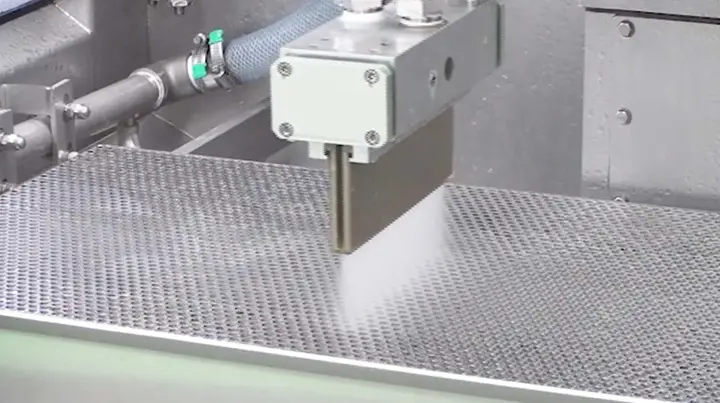
An automatic wet blasting machine is a production-grade surface treatment system that mixes water and abrasive media into a slurry and then directs that slurry onto a workpiece through a controlled blasting circuit. Unlike a simple manual cabinet, the automatic version adds programmed motion, recipe control, timed cycles, and part-handling logic so the blasting result depends less on operator technique and more on machine settings.
Within the broader abrasive blasting process family, automatic wet blasting belongs to the wet abrasive segment, which is also commonly called slurry blasting, wet sandblasting, or vapor blasting. The underlying mechanism is still mechanical surface erosion, but the water phase changes how the abrasive impacts the surface, how dust is managed, and how the process behaves on precision components.
Where Automatic Wet Blasting Fits in Surface Treatment
Automatic wet blasting is used when a manufacturer needs more than occasional cleaning or manual cosmetic touch-up. It sits between basic cabinet blasting and highly specialized finishing lines, offering an engineered route for repeatable edge preparation, selective deburring, scale removal, coating pretreatment, additive-manufacturing post-processing, peening, and visual surface refinement.
The “automatic” part can refer to several machine layers: timed blasting sequences, servo-controlled nozzle travel, automatic fixture indexing, robot-assisted loading, programmable recipes, or integrated recovery and sludge discharge. In practical procurement, buyers should look beyond the label and ask exactly which motions and controls are automated.
Core Selling Points of Wet Sandblasting Automation
The most widely cited benefit is dust-free operation in the practical sense that the water phase suppresses much of the airborne particulate created in dry abrasive impact. That does not eliminate mist or all waste handling, but it significantly changes the plant environment and the extraction strategy.
A second benefit is lower risk of abrasive impregnation on certain sensitive or coated surfaces because the water film cushions the impact. A third is the ability to produce a finer, more uniform finish on many parts where harsh dry impact would leave a rougher or less consistent appearance. The fourth is process discipline: once slurry concentration, pressure, stand-off, nozzle path, and dwell time are stabilized, repeatability improves substantially.
Automatic Wet Blasting Is More Than a Cabinet With a Timer
Some low-end systems are described as automatic simply because they run a preset cycle. In industrial terms, however, automation should mean that the process variables influencing the finish are actively managed. That includes pressure regulation, nozzle-to-part relationship, workholding repeatability, slurry recirculation, waste-sand handling, and recipe-based parameter storage.
This matters because surface treatment outcomes are highly sensitive to small changes. A machine with stable process architecture usually delivers more value than a machine with more nominal blasting power but weak control over slurry behavior and motion consistency.
How Does automatic wet blasting machine Work
An automatic wet blasting machine works as a closed industrial loop. Water and abrasive are blended into slurry, the slurry is pumped and accelerated by compressed air through a nozzle, the workpiece is exposed in an enclosed chamber, and the used mixture is then recovered, settled, filtered, and recirculated. The quality of that loop determines finish stability, maintenance effort, and real production efficiency.
Slurry Generation and Suspension Control
The process begins in the slurry tank, where water and abrasive are mixed to a target concentration. A good machine does not rely on occasional manual stirring; it keeps the abrasive suspended through circulation design, agitation, and pump sizing matched to the media characteristics. If concentration drifts during a shift, removal behavior and surface finish drift with it.
In automatic systems, concentration management becomes more important because the machine is expected to reproduce the same result over many cycles. Stable suspension is therefore a process-control function, not just a tank design detail.
Compressed Air and Nozzle Acceleration Path
From the tank, slurry moves through a wear-resistant circuit to the blast gun or nozzle assembly. Compressed air then accelerates the slurry stream, and the resulting impact energy depends on pressure, nozzle diameter, stand-off distance, impact angle, slurry density, and media size. Automatic control is valuable here because a consistent nozzle path can maintain those variables more tightly than a fully manual operation.
Where precision is important, machine builders often combine servo-driven axis motion with controlled pressure delivery rather than simply increasing air pressure. The goal is not maximum aggression; it is stable, predictable surface action.
Programmed Motion, Fixtures, and Workpiece Exposure
The defining feature of an automatic wet blasting machine is that exposure is programmed. The nozzle may travel on X/Y/Z axes, the fixture may rotate the part, or the system may combine both approaches. For complex parts, the relationship between the nozzle and the workpiece surface is often more important than peak pressure because edge radius, burr removal, and visual uniformity depend on dwell and angle consistency.
That is why automation can transform applications such as carbide-tool edge preparation, cosmetic electronics finishing, and selective deburring. Once the motion path is validated, the machine can repeat it with far less variability than a hand-held blasting gun.
Closed-Loop Recovery, Sedimentation, and Reuse
After impact, the slurry drains to a collection zone and re-enters the recovery loop. Usable media and water are recirculated, while heavier waste, broken abrasive, and removed contaminants are progressively separated. This recovery architecture is central to operating cost because it influences abrasive usage, downtime, pump wear, and the labor required to remove sludge.
Better machines make sediment management deliberate rather than improvised. Accessible tanks, controlled settling, simple discharge routines, and wear protection in the slurry path all reduce ownership burden in daily production.
Mist Management and Operator Visibility
Although wet blasting sharply reduces free dust compared with dry blasting, it still generates water mist and fine suspended contamination inside the enclosure. Automatic systems therefore need extraction, cabinet airflow, visibility management, lighting, and splash control. If visibility is poor, even an automated machine becomes harder to validate, inspect, and maintain.
PID Pressure Stability and Recipe Control
For repeatable production, pressure should not drift with compressor fluctuations, nozzle wear, or changing slurry conditions. This is where closed-loop control becomes important. PID-regulated blasting pressure, combined with HMI recipe management, helps keep the process within a validated operating window rather than relying on manual readjustment.
In automated slurry blasting, repeatability comes from controlling the loop, not from blasting harder.
| Parameter | Typical Industrial Range or Condition | Why It Matters |
|---|---|---|
| Working pressure | Typically about 0.2-0.7 MPa, application-dependent | Governs impact energy, removal rate, and finish sensitivity |
| Slurry concentration | Often controlled in a typical low-to-medium solids range by weight or volume | Affects aggressiveness, consistency, and media utilization |
| Abrasive particle size | Fine to medium grades, commonly selected by finish target and material | Influences roughness, edge conditioning, and nozzle wear |
| Compressed air demand | Dependent on nozzle size, pressure setpoint, and duty cycle | Sets compressor requirement and energy load |
| Media consumption behavior | Driven by breakdown, contamination, carryout, and recovery efficiency | Shapes consumable cost and service interval |
| Control system | Manual regulator to PLC/HMI with PID pressure management | Determines repeatability and degree of operator dependence |
Why the Working Principle Matters in Supplier Selection
Many automatic systems look similar in brochure photos. The real differences usually appear in the slurry loop, axis control, sediment handling, mist extraction, and recipe discipline. Buyers should therefore ask how the machine behaves after long production runs, not only how it performs during a short demonstration with fresh media and a clean tank.
automatic wet blasting machine vs Dry Blasting vs Other Methods
Process comparison is essential because an automatic wet blasting machine is not always the best answer. In some plants, dry blasting, shot peening, or vibratory finishing may still be the better fit depending on the surface objective, production economics, and environmental constraints.
| Comparison Point | Automatic Wet Blasting | Dry Blasting | Shot Peening | Vibratory Finishing |
|---|---|---|---|---|
| Airborne dust | Low due to water-suppressed media impact; mist still needs management | Higher and more dependent on dust collection | Moderate, enclosure- and media-dependent | Low external dust, but compound and media handling remain |
| Surface finish character | Fine, cushioned, and easier to standardize on cosmetic or precision parts | More aggressive and often rougher | Functional impact treatment rather than cosmetic finishing | Bulk smoothing and edge softening on suitable shapes |
| Media embedding risk | Generally lower on some soft or coated surfaces | Higher on some sensitive materials | Depends on media and process intent | Usually not the primary issue |
| Localization and selectivity | Good with controlled nozzle path and fixturing | Good, but often more operator-sensitive | Coverage-oriented rather than selective edge work | Limited on highly localized features |
| Repeatability in automation | High when pressure, concentration, and path are controlled | Moderate to high, but dust and media flow can vary | High in tightly specified peening systems | High for bulk batches of compatible parts |
| Environmental handling | Slurry, mist, sediment, and drain management | Dry dust collection and spent-media handling | Containment and intensity verification | Wastewater or compound management plus media separation |
Automatic Wet Blasting vs Dry Abrasive Blasting
Dry blasting remains effective where aggressive cleaning, stripping, or rough profile creation is the primary target. Automatic wet blasting gains ground when the part cannot tolerate uncontrolled dust, when finish quality is more refined, or when the process must be repeatable on small features and visible surfaces.
Automatic Wet Blasting vs Shot Peening
Shot peening is related but functionally different. The goal there is normally to impart compressive stress and improve fatigue-related performance rather than to clean, deburr, or cosmetically refine a surface. Buyers comparing these routes should distinguish blasting for surface condition from engineered peening processes described in ASTM B851 shot peening guidance.
Automatic Wet Blasting vs Vibratory Finishing
Vibratory finishing is efficient when large numbers of simple parts can be processed in bulk with all-over contact. It is less suitable when the treatment must be directional, selective, or tightly controlled on delicate edges and visible surfaces. Automatic wet blasting is stronger where geometry, access, and nozzle angle determine the outcome.
Surface Preparation and Coating Perspective
Surface treatment should also be evaluated against downstream coating requirements. Organizations involved in protective finishing frequently reference AMPP surface preparation standards because surface cleanliness and profile consistency directly influence coating performance and rework risk.
Key Specifications to Evaluate Before Buying
The best purchasing decision usually comes from a technical checklist rather than a price-only comparison. For an automatic wet blasting machine, the critical question is whether the machine can hold the process window your parts require over a full production cycle, not just under test conditions.
Pressure Range and Stability
Start with controllable blasting pressure, not the highest pressure printed on the quotation. Ask how the supplier regulates pressure during nozzle wear, compressor variation, or long shifts. If the process target involves fine edge control or visual uniformity, stable pressure is usually more valuable than peak pressure.
Slurry Concentration Discipline
The slurry system should specify concentration range, agitation logic, tank layout, and how the operator checks or corrects the mixture during production. Buyers should also ask how fines accumulation is handled because broken media can quietly change the blasting behavior.
Motion-Axis Accuracy and Path Repeatability
For precision work, axis quality matters. If the machine uses servo X/Y/Z motion or synchronized fixture movement, ask for repeatability expectations, motion smoothness, and how nozzle distance is maintained across the work envelope. Motion errors show up quickly in edge-honing consistency and localized deburring performance.
Throughput, Cycle Time, and Loading Logic
A realistic cycle-time discussion should include loading, clamping, blasting, drain-back, unloading, and any tank or filter maintenance needed between jobs. Automatic machines can lose much of their value if fixturing and part transfer are inefficient.
Workspace Footprint and Chamber Usability
Chamber dimensions alone do not define usable capacity. The RFQ should consider nozzle travel, fixture obstruction, service access, lighting, visibility, and whether future part families will need a different blast angle or part orientation.
HMI, Recipe Management, and User Permissions
A machine intended for multi-product use should support recipe storage, changeover discipline, and role-based access so operators do not inadvertently alter validated process settings. In larger factories, this is a practical quality-control feature rather than an optional software extra.
Recovery, Sediment, and Waste-Sand Handling
Slurry settling, one-step discharge routines, access to sludge zones, and pump protection should be reviewed carefully. These functions are often overlooked during purchasing, yet they strongly influence maintenance labor and daily uptime.
Utilities and Safety
Compressed air demand, electrical requirements, water management, drain routing, enclosure interlocks, emergency stops, splash control, and mist extraction should all be confirmed before installation. Safety is not only about guarding; it is also about keeping the process visible, maintainable, and predictable in routine plant use.
Applications Across Industries
An automatic wet blasting machine is most valuable when the process need is specific. Different industries use the same underlying wet blasting principle, but the desired outcome may be edge preparation, burr removal, oxide cleaning, adhesion promotion, or cosmetic texturing.
| Application Type | Target Industry | Workpiece Example | Process Benefit |
|---|---|---|---|
| Edge honing of cutting tools | Carbide tooling and precision machining | Inserts, end mills, drills | Controlled edge preparation and more repeatable K-factor development |
| Burr removing of metal parts | Machining, stamping, and component production | Precision machined parts, punched parts | Selective deburring with lower manual finishing effort |
| Scale removal from forgings or bars | Forging and steel processing | Forged components, rods, bar stock | Removes oxide and scale with lower airborne dust than dry-only methods |
| Pretreatment before coating | Fabrication, appliance, transport components | Brackets, housings, formed panels | Improves cleanliness and supports more consistent coating adhesion |
| AM post-processing | Additive manufacturing | 3D-printed metal parts | Refines surface texture and removes loose surface residue |
| Peening and surface conditioning | Functional metal components | Wear parts, fatigue-sensitive components | Controlled impact for engineered surface condition |
| Glass frosting | Architectural and decorative glass | Glass panels, display parts | Creates a more even matte or frosted appearance |
| 3C device finishing | Consumer electronics supply chain | Frames, shells, covers | Improves cosmetic consistency and tactile smoothness |
Cutting Tool Edge Honing
Among the most demanding uses of automatic wet blasting is carbide-tool edge preparation. Here the machine must keep nozzle exposure, angle, and abrasive behavior tightly controlled so the edge radius stays within process tolerance. In that context, tool edge honing applications are less about “cleaning” and more about geometric conditioning.
Deburring of Machined and Stamped Parts
Selective deburring is another strong fit because automation can reduce operator variability while preserving critical surfaces. For plants handling repetitive burr issues on precision components, metal-part deburring processes often justify automation when manual finishing becomes inconsistent or labor-intensive.
Coating Pretreatment and Surface Activation
In pretreatment lines, wet blasting is not an isolated finishing step; it is part of a downstream system that may include cleaning, conversion treatment, and coating. The process is evaluated by how well it prepares the substrate for the next stage rather than by visual appearance alone.
Additive Manufacturing, Glass, and 3C Finishing
These segments typically emphasize appearance, fine texture, and consistency across visible surfaces. Automatic wet blasting is useful because it can standardize exposure across batches while avoiding the harsher cosmetic signature that some dry processes leave behind.
Equipment Selection Guide
The term “automatic wet blasting machine” covers a wide range of equipment architectures. The correct selection depends on production scale, part geometry, required precision, and how much flexibility the factory needs for future product changes.
| Configuration / Model Tier | Target Production Scale | Workpiece Size Range | Precision Level | Recommended Applications |
|---|---|---|---|---|
| R&D robot-assisted platform | Process development and sample testing | Small to medium mixed parts | High | New part validation, abrasive trials, recipe development |
| Compact automatic cabinet | Small-lot production | Small parts | Medium | Light deburring, cleaning, entry-level automation |
| Standard single-chamber production cabinet | Routine batch manufacturing | Small to medium parts | Medium to high | Batch finishing with repeatable cycles |
| Single-piece dedicated machine | Repetitive part-by-part processing | Small to medium dedicated parts | High | Stable orientation and controlled exposure of one part family |
| Servo multi-axis complex-part system | Precision production | Small to medium complex geometries | Very high | Edge honing, selective deburring, intricate surfaces |
| Plate-part dedicated machine | Flat or plate-like production | Medium to large flat parts | High | Uniform treatment of plates, panels, and sheet-based components |
| Round-rod processing system | Continuous or semi-continuous handling | Long cylindrical workpieces | Medium to high | Scale removal and conditioning of rods or bars |
| Double-chamber production system | Higher-throughput manufacturing | Small to medium production parts | High | Reduced idle time and more continuous batch flow |
R&D and Flexible Validation Systems
For new applications, a flexible development platform is usually the lowest-risk starting point. An R&D robot blasting cell is relevant where the factory needs to test abrasive grades, nozzle paths, and exposure strategies before freezing a dedicated production layout.
Standard Production Cabinets
Many plants do not need full robotic handling to gain meaningful process control. A conventional automatic batch layout, especially a single-chamber production cabinet, often provides the best balance of footprint, repeatability, and maintainability for mid-volume work.
Dedicated Single-Piece and Complex-Part Systems
When one part family dominates the workload, a dedicated single-piece machine can simplify fixturing and reduce changeover. For more complicated geometries, the better path is often a servo-driven multi-axis system that can maintain angle, distance, and dwell across changing surfaces.
High-Throughput Production Layouts
At the high-output end, automation value often comes from minimizing idle time rather than merely accelerating the blasting stream. Double-chamber or parallelized systems make sense when loading and unloading have become the rate-limiting step.
How to Use the Selection Matrix
The most robust buying strategy is to choose the simplest configuration that can still meet finish quality, repeatability, and cycle-time goals. Over-automating a straightforward process adds cost and maintenance, while under-automating a precision process usually creates hidden scrap and labor loss.
Cost, Lead Time and ROI Considerations
Cost analysis for an automatic wet blasting machine should include capital, consumables, maintenance, utilities, and quality effects. A lower quoted price does not necessarily produce a lower total cost of ownership if the machine requires frequent readjustment, poor sludge management, or excessive manual intervention.
Main Price Drivers
The most important price variables are chamber size, automation level, servo axes, fixture complexity, slurry recovery design, wear-resistant components, HMI capability, and extraction hardware. A basic cabinet with timed motion is a different investment category from a multi-axis system with recipe-driven process control and integrated part handling.
Consumables also matter. Abrasive life, nozzle wear, pump wear, slurry contamination rate, and cleanup labor all contribute to cost over time. Buyers should compare not only what the machine costs to buy, but also what it costs to keep stable.
Typical Lead-Time Structure
Lead time is usually shortest for standard platforms and longer for custom automation. A realistic schedule often includes sample testing, process approval, engineering, manufacturing, factory testing, shipping, installation, commissioning, and operator training. Projects become longer when they involve custom fixtures, robot programming, integrated loading systems, or special environmental requirements.
ROI Framing by Application
In deburring, ROI often comes from reducing manual labor and cutting rework caused by inconsistent edge quality. In tool edge preparation, the gain may come from better edge consistency, more stable coating performance, or longer usable tool life. In coating pretreatment, the return may appear as better adhesion and fewer downstream defects.
The key is to identify the dominant current loss. If the bottleneck is labor, automation should be measured against labor and throughput. If the bottleneck is quality variation, the ROI model should emphasize scrap reduction, process repeatability, and reduced corrective finishing.
Hidden Ownership Costs
Several hidden costs tend to be underestimated during procurement: sludge removal time, visibility problems, nozzle replacement frequency, recipe instability, and downtime caused by poorly protected pumps or valves. A machine that looks less expensive upfront can become more expensive if it is difficult to keep in a validated process window.
Why Process Validation Improves Payback Confidence
ROI calculations become more credible when they are tied to sample testing and defined acceptance criteria. A supplier that can validate surface outcome, abrasive choice, and cycle logic before the final design stage reduces technical uncertainty and shortens the learning curve after installation.
Why Choose DassiAuto — Our Company
DassiAuto Intelligent Equipment Co., Ltd is a Chinese manufacturer established in 2012 and focused on wet blasting technology for industrial surface treatment. According to its published company profile, it operates as a national high-tech enterprise under the ISO 9001 quality management standard, with invention patents, utility model patents, and software copyrights related to blasting equipment and control systems.
Its stated scope covers planning, design, manufacturing, sales, and application development across the surface-treatment equipment value chain. The company identifies eight equipment configurations spanning R&D, batch production, and application-specific systems, with engineering features that include PID closed-loop slurry pressure control, servo-driven X/Y/Z linkage with 0.02 mm control accuracy, HMI recipe management with hierarchical permissions, automatic waste-sand sedimentation with one-click discharge, and dust-collection systems designed to reduce water mist.
DassiAuto also lists customer references in carbide cutting tools and related manufacturing fields, including Wecan, Ruian, Huareal, Metcera, OKE, YG, Kelite, and XTC. Its published service model covers sample testing, process development, equipment design, manufacturing under quality control, installation, commissioning, operator training, after-sales service, spare parts, TR-series abrasive resupply, and process optimization. From a procurement standpoint, that describes a manufacturer organized around process-verified solutions rather than shipment of a generic blasting cabinet alone.
FAQ
Q1. How do I know whether an automatic wet blasting machine is better than a manual wet blasting cabinet for my parts?
The decision usually depends on repeatability, labor intensity, and geometric complexity. If your process outcome changes significantly between operators, or if cycle time is dominated by manual handling and gun movement, automation usually becomes easier to justify. For highly cosmetic or tolerance-sensitive parts, programmed motion is often the decisive factor.
Q2. Can a supplier run sample testing before the final machine configuration is fixed?
Yes, and that is usually the most practical way to reduce project risk. Sample testing helps confirm abrasive grade, pressure window, fixture direction, nozzle path, and achievable surface outcome before the equipment layout is frozen. It also improves the accuracy of the commercial quotation.
Q3. What level of customization is normal for an automatic wet blasting machine?
Some degree of customization is common even on standard platforms. Fixtures, nozzle arrangements, recipe sets, part rotation, loading logic, and recovery details are often adjusted to the application. The important point is whether those changes are process-driven rather than cosmetic options added without validation.
Q4. What should be included in installation, commissioning, and operator training?
A complete handover should cover utilities, machine placement, startup checks, safety interlocks, parameter setup, trial production, maintenance routines, and routine troubleshooting. Operator training should include not only how to run the machine but also how to recognize slurry drift, visibility problems, and wear-related process changes.
Q5. How important are spare parts and abrasive resupply in the purchasing decision?
They are very important because blasting systems are wear-intensive by nature. Pumps, nozzles, valves, seals, windows, and matched abrasive grades all influence uptime and process consistency. A machine with weak parts support can quickly become difficult to keep in production even if the initial installation goes well.
Q6. How long does ROI usually take for an automatic wet blasting machine?
There is no universal payback period because ROI depends on labor cost, current scrap rate, throughput demand, and how much the process improves downstream performance. Projects replacing manual deburring or stabilizing high-value precision finishing often justify faster than projects where the existing process is already consistent. The most reliable ROI estimate comes from tying sample-tested process results to actual plant labor, quality, and output data.