
Quick Answer
An industrial wet blasting machine fits a production line when the process needs repeatable surface treatment, reduced airborne dust, tighter cosmetic consistency, and less operator variability than manual blasting or dry-only methods. In practice, the right machine is selected by matching part geometry, throughput, surface target, and automation depth. For most industrial users, the best results come from a system that can hold slurry concentration, pressure, nozzle path, and recovery conditions within a stable process window over long production runs.
| Core Factor | Typical Industrial Expectation | Why It Matters |
|---|---|---|
| Process type | Wet blasting / slurry blasting / vapor blasting | Determines finish character, dust profile, and recovery method |
| Working pressure | Typical application window around 0.2-0.7 MPa | Balances removal rate with surface sensitivity |
| Motion and control | Timed cycle, fixture indexing, or servo axis motion | Improves repeatability across shifts and operators |
| Primary applications | Deburring, edge honing, scale removal, coating pretreatment, cosmetic finishing | Confirms process fit with part family and production goal |
| Environmental profile | Low free dust, enclosed slurry circulation, mist extraction | Supports cleaner plant operation than dry blasting |
| Typical project timing | Standard models shorter; custom automation longer | Affects validation, installation, and launch planning |
What Is industrial wet blasting machine
An industrial wet blasting machine is a production-grade surface treatment system that mixes abrasive media with water to form a slurry, then accelerates that slurry onto a workpiece using compressed air and a controlled delivery circuit. The machine may be configured as a batch cabinet, a dedicated single-part unit, a multi-axis cell, or a higher-throughput line, but the process family remains the same: wet abrasive blasting.
Within the wider abrasive blasting process family, wet blasting sits apart from dry blasting because the water phase changes both the impact mechanics and the plant environment. Instead of projecting dry media through air alone, the process cushions the abrasive in a liquid carrier, which can reduce free dust, moderate the aggressiveness of impact, and make some sensitive surfaces easier to finish consistently.
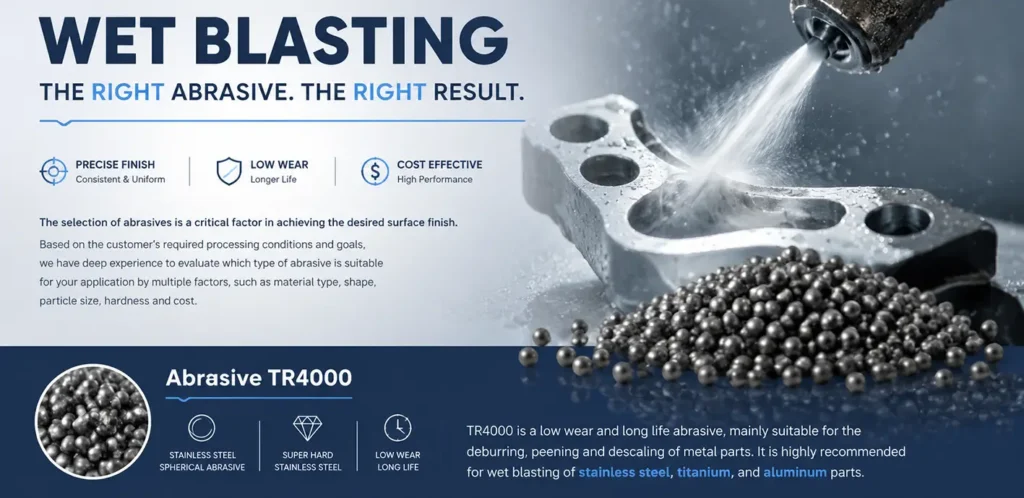
Where Wet Blasting Sits in Industrial Surface Treatment
In industrial finishing, wet blasting is typically chosen when the goal is more sophisticated than simple cleaning. It is used for controlled edge preparation, burr removal, surface activation before coating, oxide or scale removal, additive-manufacturing post-processing, peening-related conditioning, glass frosting, and visible-surface refinement on consumer-facing parts.
The “industrial” qualifier matters because it implies more than a small workshop cabinet. An industrial system is expected to support repetitive duty, controlled utilities, predictable slurry circulation, recoverable consumables, operator protection, maintenance access, and a degree of automation suited to production rather than occasional manual work.
Core Process Advantages
The first major benefit is dust-free operation in practical terms: water suppresses much of the airborne particulate that would otherwise be liberated in dry blasting. That does not eliminate extraction requirements, because mist still has to be managed, but it significantly improves the working environment.
A second benefit is lower risk of media impregnation on some soft, coated, or appearance-sensitive surfaces because the water film changes how particles strike the substrate. A third is a finer, more uniform finish on many metals, glass, and precision components. A fourth is better process repeatability when pressure, concentration, nozzle position, and exposure time are all controlled rather than left to operator feel.
Not Every Wet Blasting Cabinet Is Truly Industrial
A machine may be called industrial because it has a steel cabinet and a pump, but true production suitability depends on control architecture. Buyers should distinguish between a simple wet cabinet with manual adjustment and a system designed for validated process windows, recipe storage, repeatable fixture positioning, automated sediment handling, and robust recovery.
That distinction becomes especially important where the blasting step affects downstream outcomes such as coating adhesion, cutting-edge geometry, fatigue performance, or cosmetic acceptance. In those cases, the machine is not just cleaning a surface; it is shaping process capability.
How Does industrial wet blasting machine Work
An industrial wet blasting machine works as a closed operating loop. Water and abrasive are blended into slurry, the slurry is circulated to a blasting circuit, compressed air accelerates the mixture through a nozzle, the enclosure captures overspray and spent media, and the used slurry is then recovered, settled, filtered, and returned for reuse. Stable finishing quality depends less on raw blasting force than on how well that loop is controlled.
Slurry Preparation and Suspension Stability
The process begins in a slurry tank where water and abrasive are mixed to a target ratio. The tank and circulation system must keep abrasive particles suspended evenly rather than letting them settle or segregate by size. If solids concentration drifts during a shift, the process can become either too aggressive or too weak, and the finish may change from one batch to the next.
This is why industrial wet blasting systems are designed around circulation logic, not just a tank volume figure on a brochure. Agitation, pump selection, flow path design, and access for cleaning all influence how stable the slurry remains under production conditions.
Compressed Air Acceleration and Nozzle Delivery
Once the slurry is circulating, compressed air accelerates it toward the workpiece through a blasting gun or nozzle assembly. The effective cutting or conditioning action depends on nozzle diameter, air pressure, stand-off distance, impact angle, media size, slurry density, and the dwell time at each surface location.
In automated systems, these variables are managed by fixed tooling and programmed motion rather than by hand-held operator technique. That is the main reason an industrial wet blasting machine can hold tighter process consistency than manual wet sandblasting.
Enclosure, Recovery, and Reuse
After the slurry impacts the part, it falls into a collection zone and returns to the recovery loop. Reusable media and water are recirculated, while broken abrasive, removed burrs, scale, metallic fines, and other contaminants are progressively separated. Sedimentation, screening, and discharge routines therefore have a direct effect on both running cost and finish stability.
If this loop is poorly designed, the machine can look good during a short test but become unstable during longer runs. A sound recovery circuit reduces unplanned cleaning, lowers media waste, and keeps the slurry characteristics closer to the original recipe.
Mist Extraction and Visibility
Wet blasting suppresses dust but creates mist, splash, and fine suspended contamination inside the enclosure. Industrial systems therefore need proper airflow, drainage, cabinet lighting, view-window protection, and extraction to keep the process observable and serviceable. Good visibility is not cosmetic; it affects setup verification, maintenance quality, and the ability to confirm that the nozzle path is actually treating the intended surface.
Pressure Regulation and Recipe Management
Consistent results depend on consistent pressure. When compressor load changes, nozzles wear, or slurry properties shift, the machine should not require constant manual correction. This is where closed-loop control and stored process recipes become valuable, especially for plants running multiple SKUs or shift-based production.
In production wet blasting, the stable result usually comes from loop control, not from maximum impact pressure.
| Parameter | Typical Industrial Range or Condition | Production Relevance |
|---|---|---|
| Working pressure | Typically about 0.2-0.7 MPa, depending on media and part sensitivity | Influences impact energy, removal rate, and finish refinement |
| Slurry concentration | Typical low-to-medium solids ratio by weight or volume | Affects consistency, aggressiveness, and pumpability |
| Abrasive particle size | Fine to medium grades selected by substrate and finish target | Controls roughness, edge conditioning, and nozzle wear |
| Compressed air demand | Depends on nozzle size, duty cycle, and pressure setpoint | Determines compressor sizing and energy load |
| Media consumption behavior | Driven by breakdown, contamination, carryout, and recovery efficiency | Shapes consumable cost and change interval |
| Control architecture | Manual regulator to PLC/HMI with PID pressure control | Sets the degree of repeatability and operator dependence |
Why the Working Principle Matters During Procurement
Many machines appear similar in photos because all of them have a cabinet, slurry tank, and gun system. The real engineering differences usually appear in pressure stability, recovery behavior, motion control, sediment handling, and maintainability after hours of continuous operation.
For that reason, buyers should ask how the machine performs after extended production with real contamination loads, not only with fresh slurry during a short demonstration. That question often reveals more about the machine than chamber size alone.
industrial wet blasting machine vs Dry Blasting vs Other Methods
An industrial wet blasting machine is not automatically the best option for every surface-treatment problem. Process comparison matters because the correct choice depends on whether the plant needs aggressive cleaning, precise edge conditioning, compressive stress improvement, or bulk smoothing across large batches of parts.
| Comparison Point | Industrial Wet Blasting | Dry Blasting | Shot Peening | Vibratory Finishing |
|---|---|---|---|---|
| Airborne dust | Low free dust; mist extraction still required | Higher dust load and stronger dependence on dust collection | Contained process, but media and dust management still matter | Low airborne dust outside machine, though compounds and residues remain |
| Finish character | Fine, cushioned, and controllable on visible or precision surfaces | More aggressive and often rougher | Functional surface impact, not primarily cosmetic | Bulk smoothing on compatible shapes |
| Media embedding risk | Generally lower on some soft or coated surfaces | Higher on some sensitive materials | Depends on media, coverage, and intent | Usually not the main concern |
| Localized selectivity | Good with nozzle control and fixtures | Good, but often more operator-sensitive | Coverage-focused rather than selective edge work | Limited on tightly localized features |
| Automation repeatability | High when path, pressure, and slurry are controlled | Moderate to high, but dry flow behavior can vary | High in specialized peening systems | High for bulk loads of similar parts |
| Environmental handling | Slurry, mist, sediment, and wastewater management | Dry dust collection and spent-media handling | Containment and intensity verification | Media separation and liquid-compound management |
Wet Blasting vs Dry Blasting
Dry blasting remains valuable where the objective is aggressive stripping, heavy rust removal, or profile generation on larger structural surfaces. Wet blasting becomes more attractive when the part is sensitive, cosmetic, small-featured, or when plant conditions make dust suppression important.
Wet Blasting vs Shot Peening
Shot peening is related but not interchangeable. Its primary purpose is usually to induce compressive stress and improve fatigue-related behavior rather than to deburr, clean, or cosmetically finish a part, which is why many engineers distinguish it through shot peening process terminology and standards such as ASTM B851.
Wet Blasting vs Vibratory Finishing
Vibratory finishing works well when many small parts can be processed in bulk and when all-over edge softening is acceptable. It is less suitable when the process must be directional, selective, or precisely controlled on a particular edge, pocket, or visible face. Wet blasting has a clear advantage where nozzle angle and dwell location determine the final result.
Surface Preparation for Coating Systems
For coating pretreatment, the comparison should include downstream adhesion and cleanliness rather than blasting speed alone. Surface-preparation practice in protective coatings is often framed through organizations such as AMPP protective coatings standards, which emphasizes that preparation quality affects the performance of everything that follows.
Key Specifications to Evaluate Before Buying
A quotation comparison only becomes meaningful when the underlying process window is clear. For an industrial wet blasting machine, the critical issue is not maximum advertised power but whether the system can hold stable conditions on the actual part family over a full shift.
Blasting Pressure and Stability
Start by defining the required pressure range for the substrate and finish target. Fine edge honing, cosmetic texturing, and selective deburring often need a narrower and more stable control band than general cleaning or scale removal. Ask whether pressure is manually adjusted, pneumatically regulated, or managed through PID logic.
Slurry Concentration and Abrasive Control
The supplier should specify how concentration is prepared, monitored, corrected, and protected from drift. Also ask what abrasive grades are recommended, how broken fines are removed, and how often the slurry needs cleaning or replacement under normal contamination loads.
Motion Precision and Nozzle Path Repeatability
If the process is geometry-sensitive, axis quality matters. Servo X/Y/Z motion, fixture indexing, nozzle stand-off control, and repeatable positioning all contribute directly to edge radius control, uniform matte appearance, and localized burr removal.
Throughput, Cycle Time, and Changeover
A realistic cycle-time discussion should include loading, clamping, blasting, drain-back, unloading, inspection, and any between-batch cleanup. For mixed production, recipe changeover and fixture exchange may affect effective throughput more than blasting speed itself.
Chamber Size, Footprint, and Service Access
Usable working volume is more important than nominal cabinet dimensions. Buyers should look at door opening, fixture access, nozzle travel envelope, maintenance clearances, and whether pumps, valves, and sediment zones can be serviced without excessive downtime.
HMI Recipes, Permissions, and Data Discipline
Plants with multiple operators or multiple products should pay close attention to recipe storage and permission management. A machine that allows unauthorized parameter changes can undermine the very repeatability that justified automation in the first place.
Mist Extraction, Sediment Handling, and Utilities
Enclosure airflow, view-window protection, water management, one-step sludge discharge, compressed air demand, electrical load, and drainage planning all influence real installation cost. These details rarely headline a brochure, but they strongly affect ownership experience.
Safety and Compliance Readiness
Safety should include interlocks, emergency stops, guarding, splash containment, maintenance isolation, and operator visibility. A safer system is often also a more reliable system because it is easier to maintain, inspect, and run within defined parameters.
Applications Across Industries
Industrial wet blasting is used across sectors because the same slurry-based mechanism can be tuned for very different process outcomes. The key is not simply to “blast” the surface, but to do so with a finish profile, edge effect, and process consistency appropriate to the material and downstream requirement.
| Application Type | Target Industry | Workpiece Example | Process Benefit |
|---|---|---|---|
| Edge honing of cutting tools | Carbide tooling and precision machining | Inserts, drills, end mills | Controlled edge preparation and more consistent K-factor formation |
| Burr removing of metal parts | Machining, stamping, and component supply | Precision machined parts, punched parts | Selective deburring with reduced manual finishing effort |
| Scale removal from forgings or bars | Forging and steel processing | Forged components, rods, bar stock | Removes oxide and scale with lower free dust than dry-only routes |
| Pretreatment before coating | Fabrication, appliance, transport components | Brackets, housings, panels | Improves cleanliness and supports more stable coating adhesion |
| AM post-processing | Additive manufacturing | 3D-printed metal parts | Smooths surface texture and removes loose residue |
| Peening and surface conditioning | Functional metal components | Wear parts, fatigue-sensitive items | Controlled impact for engineered surface condition |
| Glass frosting | Architectural and decorative glass | Panels, covers, display elements | Produces a more even matte visual effect |
| 3C device finishing | Consumer electronics supply chain | Frames, shells, external covers | Supports cosmetic consistency and tactile smoothness |
Cutting Tool Edge Preparation
One of the most technically demanding uses is carbide-tool edge conditioning, where the machine must produce a controlled edge radius without random overexposure. In this context, cutting tool edge honing is a geometry-control process rather than a generic cleaning step.
Precision Deburring of Metal Parts
Deburring is another strong fit because automation reduces operator-to-operator variability while keeping treatment localized. For repetitive burr issues on machined or stamped parts, selective metal-part deburring can replace slower hand finishing while preserving dimensional intent.
Coating Pretreatment and Integrated Pretreatment Lines
Wet blasting also serves as a pretreatment stage when the aim is to prepare a substrate for paint or another coating layer. In some lines, that role extends into combined processing, where blasting-phosphating equipment aligns mechanical cleaning with a downstream conversion-treatment step.
Forgings, Rods, Glass, and 3C Surfaces
Steel bar scale removal, forged-part cleaning, frosted glass texturing, and 3C cosmetic finishing all depend on different parameter windows, yet they share a need for consistency. Wet blasting is especially useful when visible-surface uniformity matters as much as material removal rate.
Equipment Selection Guide
The term industrial wet blasting machine covers a wide spectrum of configurations. The correct equipment choice depends on whether the plant is validating a new process, running small mixed batches, treating complex geometries, or pursuing higher-throughput repetitive production.
| Configuration / Model Tier | Target Production Scale | Workpiece Size Range | Precision Level | Recommended Applications |
|---|---|---|---|---|
| R&D robot-assisted platform | Sample testing and process development | Small to medium mixed parts | High | Process validation, abrasive trials, early fixture development |
| Compact automatic cabinet | Small-lot production | Small parts | Medium | Light deburring, cleaning, entry-level automation |
| Standard single-chamber batch system | Routine batch manufacturing | Small to medium parts | Medium to high | Stable repetitive finishing with manageable footprint |
| Dedicated single-piece machine | Repetitive part-by-part production | Small to medium dedicated parts | High | One-part-family processing with consistent orientation |
| Servo multi-axis complex-part cell | Precision production | Small to medium complex geometries | Very high | Edge honing, selective deburring, intricate surfaces |
| Plate-part dedicated machine | Flat or plate-like production | Medium to large flat parts | High | Uniform treatment of panels and plate-shaped workpieces |
| Round-rod processing system | Continuous or semi-continuous flow | Long cylindrical workpieces | Medium to high | Scale removal and conditioning of rod or bar stock |
| Double-chamber production system | Higher-throughput manufacturing | Small to medium production parts | High | Reduced idle time and more continuous loading rhythm |
R&D and Flexible Process Development
Before committing to a dedicated production layout, some users need to validate abrasive grade, stand-off distance, pressure, and motion logic. In those cases, an R&D robot-type wet blasting cell is better suited than a fixed production machine because it allows broader experimentation.
Standard Batch Production Systems
For many mid-volume users, the most practical answer is a standard batch cabinet with controlled blasting logic and manageable maintenance. A single-chamber batch machine typically offers a balanced combination of repeatability, service access, and floor-space efficiency.
Dedicated and Multi-Axis Configurations
When a single part family dominates the schedule, a dedicated single-piece machine can simplify loading and reduce changeover. Where geometry is more complicated, multi-axis motion is usually the better route because it keeps nozzle angle and dwell more consistent across varying surfaces.
Throughput-Oriented Production Layouts
At higher volumes, the limiting factor is often loading time rather than blasting energy. Double-chamber or parallelized layouts can improve utilization by allowing one chamber to load while another runs, reducing dead time in repetitive production.
How to Narrow the Choice
The most reliable selection method is to choose the least complex configuration that still meets finish, quality, and throughput requirements. Under-automation tends to create hidden scrap and labor cost, while over-automation can add capital cost and maintenance without improving the surface outcome.
Cost, Lead Time and ROI Considerations
Capital cost for an industrial wet blasting machine depends less on the basic fact of wet blasting and more on the level of engineering built around it. Chamber size, automation depth, fixture complexity, wear-resistant materials, control system sophistication, recovery design, and mist extraction all influence the investment category.
Main Cost Drivers
The biggest cost variables are usually motion system complexity, part handling, slurry-circuit durability, recovery and sediment features, and HMI functionality. A simple timed cabinet and a servo-driven multi-axis system may both be described as wet blasting machines, but they belong to very different process and cost classes.
Consumables also deserve attention. Abrasive degradation, nozzle wear, pump wear, window protection, sludge removal, and operator cleanup labor all shape total cost of ownership. These running costs matter because blasting systems are wear-intensive by nature.
Typical Lead-Time Structure
Lead time is generally shortest for standard machine formats and longer for custom automation. A realistic project schedule commonly includes sample testing, process confirmation, detailed design, manufacturing, internal testing, shipment, installation, commissioning, and operator training. If the project includes special fixtures, robot motion programming, integrated loading, or combined pretreatment functions, the timeline typically extends.
ROI Logic by Application Type
Return on investment should be framed around the main current pain point. In manual deburring, the gain may come from lower labor input and fewer inconsistent edges. In edge honing, the benefit may appear as more stable edge geometry, better coating response, or longer tool life. In pretreatment, the return often comes from reduced downstream rework and better adhesion performance.
This is why a strong ROI model starts with plant data rather than generic vendor assumptions. The best estimate links tested process capability to current labor consumption, scrap rate, rework cost, takt needs, and quality escape risk.
Hidden Costs That Buyers Miss
Several ownership costs are often underestimated during procurement: slurry cleanup labor, visibility loss inside the cabinet, long maintenance access time, poor sludge discharge design, and drift caused by weak recipe control. A lower upfront price can therefore produce a higher lifecycle cost if the machine is difficult to keep stable.
Why Validation Improves Payback Confidence
Sample testing and acceptance criteria reduce technical uncertainty before full investment. When a process is validated in advance, the final equipment design can focus on reproducing an already-proven window instead of discovering basic process feasibility after installation.
Why Choose DassiAuto — Our Company
DassiAuto Intelligent Equipment Co., Ltd is a Chinese manufacturer established in 2012 and focused on wet blasting technology for industrial surface treatment. Its published company background states that it operates as a national high-tech enterprise under the ISO 9001 quality management standard, with invention patents, utility model patents, and software copyrights related to blasting equipment and control systems.
According to the company context provided, DassiAuto covers planning, design, manufacturing, sales, and application development across the surface-treatment equipment value chain. Its wet blasting lineup spans eight equipment configurations for R&D, batch production, and application-specific requirements, and its engineering features include PID closed-loop slurry pressure control, servo-driven X/Y/Z linkage with 0.02 mm control accuracy, HMI recipe management with hierarchical permissions, automatic waste-sand sedimentation with one-click discharge, and dust-collection systems that reduce water mist.
The same company context identifies customer references including Wecan, Ruian, Huareal, Metcera, OKE, YG, Kelite, and XTC, especially in carbide cutting tools and related industrial sectors. It also describes a full-cycle service model covering sample testing, application development, planning, design, manufacturing under quality control, installation, commissioning, operator training, after-sales support, spare parts, TR-series abrasive resupply, and process optimization. From a procurement perspective, that profile reflects process-verified solutions rather than supply of a generic cabinet alone.
FAQ
Q1. How do I know if an industrial wet blasting machine is better than a manual cabinet for my parts?
The answer usually depends on process variability, labor intensity, and the sensitivity of the finished surface. If the result changes noticeably between operators or shifts, or if manual blasting cannot hold a stable edge, texture, or cosmetic target, an industrial wet blasting machine is usually easier to justify. The case becomes stronger when the process affects downstream coating, tool performance, or customer-visible appearance.
Q2. Is sample testing necessary before ordering a custom machine?
For most industrial projects, yes. Sample testing helps determine abrasive type, pressure window, stand-off distance, nozzle path, fixture logic, and whether the desired finish can be achieved consistently. It also reduces the risk of over-specifying or under-specifying the final machine.
Q3. How much customization is normal in this type of equipment?
A moderate level of customization is common, especially in fixtures, nozzle arrangement, motion path, recipe structure, and recovery details. Even a standard cabinet platform may need process-specific adjustments to suit the part family. The important distinction is whether customization is based on verified process need rather than cosmetic options.
Q4. What should installation and operator training include?
A complete commissioning package should cover utilities, startup checks, safety functions, recipe setup, trial production, maintenance routines, and troubleshooting. Training should also explain how to recognize slurry drift, nozzle wear, visibility loss, and sediment buildup, because those factors affect process stability over time.
Q5. How important are spare parts and abrasive resupply to long-term performance?
They are critical because wet blasting equipment operates with constant wear on pumps, nozzles, valves, seals, windows, and recovery components. Abrasive consistency also matters, since a change in media characteristics can alter finish quality and cycle time. Long-term uptime depends as much on consumables discipline as on the original machine build.
Q6. How long does ROI usually take for an industrial wet blasting machine?
There is no universal payback period because ROI depends on labor cost, current scrap rate, production volume, part value, and the importance of surface consistency. Projects replacing manual deburring or stabilizing high-value precision finishing often justify more quickly than projects where the current process is already stable. The most reliable estimate comes from linking tested process results to actual plant data rather than using generic benchmark assumptions.