
Quick Answer
A wet blasting machine supplier is the right fit when it can match machine configuration, slurry stability, pressure control, and application know-how to your actual parts rather than offering a generic cabinet. For most industrial buyers, the best supplier is one that can support repeatable wet blasting for deburring, edge honing, coating pretreatment, scale removal, and cosmetic finishing with controlled dust behavior, stable process parameters, and realistic implementation support from testing through commissioning.
| Core Factor | Typical Conclusion | Why It Matters |
|---|---|---|
| Process type | Wet blasting / slurry blasting / vapor blasting | Determines finish mechanism, dust profile, and media behavior |
| Pressure range | Typical operating range about 0.2-0.7 MPa | Balances removal rate with surface sensitivity |
| Precision level | From manual-assisted cabinets to servo-controlled multi-axis systems | Affects repeatability and geometry control |
| Main applications | Deburring, edge honing, coating pretreatment, AM post-processing, cosmetic finishing | Confirms application fit before purchase |
| Environmental profile | Lower free dust than dry blasting, with mist extraction still required | Supports cleaner enclosed processing |
| Lead-time band | Standard systems typically shorter than custom automated lines | Shapes project planning and ROI timing |
What Is wet blasting machine supplier
A wet blasting machine supplier is not just a seller of cabinets that spray abrasive slurry. In industrial sourcing terms, it is a company that provides machines, abrasive-process matching, engineering guidance, and production support for wet sandblasting, slurry blasting, or vapor blasting applications. That places the supplier within the wider abrasive blasting process family, but with a specific focus on water-carried abrasive impact rather than dry-media projection alone.
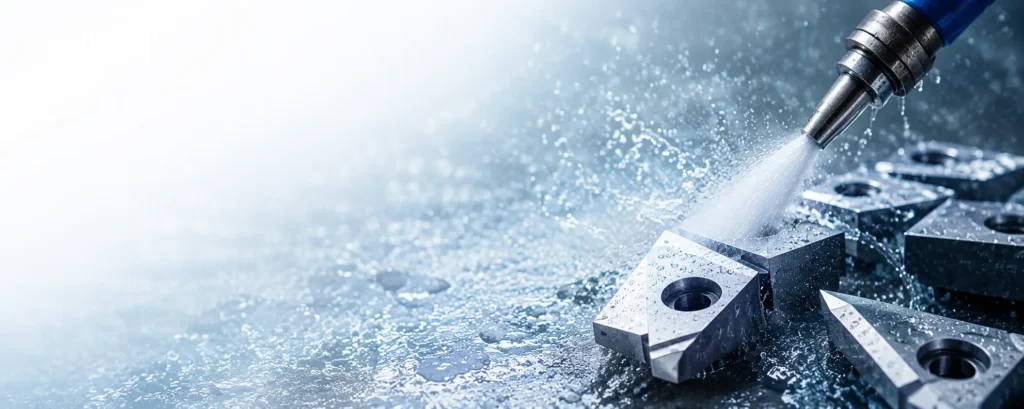
Technically, wet blasting uses fine abrasive particles suspended in water and accelerated toward the workpiece through compressed air. The water phase changes the cutting behavior, suppresses free airborne dust, and often makes the finish more uniform on sensitive surfaces. Because of that, the supplier’s role is not simply to ship hardware; it is to align media, pressure, nozzle path, workholding, and recovery design with the finish target.
Where a Wet Blasting Supplier Sits in Surface Treatment
In the surface-treatment chain, wet blasting typically sits between coarse cleaning processes and final functional or cosmetic finishing. It may be used before coating, before PVD or CVD tool coating, after machining, after additive manufacturing, or as part of a deburring and edge-conditioning route. A supplier in this segment therefore needs application knowledge across multiple process stages, not only machine assembly capability.
That distinction matters in procurement. A company may fabricate a cabinet successfully yet still be a weak wet blasting machine supplier if it cannot define slurry chemistry, abrasive grade, nozzle wear logic, or sediment-discharge strategy under production conditions.
Core Selling Points Buyers Usually Expect
The strongest reasons for specifying wet blasting instead of dry blasting are often dust suppression, lower risk of harsh surface attack on selected substrates, and more even finishing on precision parts. When the abrasive is cushioned by water, it can produce a refined matte texture or controlled edge effect with less uncontrolled scatter than a dry process on the same part family.
Another major factor is process consistency. In a well-designed system, slurry concentration, blasting pressure, nozzle dwell, and recovery conditions are controlled tightly enough to support repeatability over longer runs. That is especially important in tool preparation, component deburring, and visible-surface finishing where cosmetic or functional differences become quality defects.
Supplier Capability vs Machine Capability
Buyers often compare machines by chamber size, nozzle count, or quoted pressure alone. In practice, the more meaningful comparison is between supplier capabilities: Can the supplier validate the application? Can it size the recovery loop correctly? Can it integrate recipe management, motion control, and waste handling into a stable production method?
A credible wet blasting machine supplier should therefore be evaluated on both equipment and process competence. The machine creates the physical platform, but the supplier defines whether that platform can achieve the required surface result repeatedly and economically.
How Does wet blasting machine supplier Work
The phrase “how does wet blasting machine supplier work” can sound awkward, but in sourcing practice it points to a real question: how does the supplier’s equipment actually perform the process, and what engineering functions separate a production-grade system from a basic slurry cabinet? The answer lies in the interaction among slurry preparation, compressed-air acceleration, enclosed blasting, recovery circulation, sedimentation, and controls.
Slurry System: Water and Abrasive in Suspension
The process begins with a mixing tank or reservoir where water and abrasive are combined into slurry. This slurry must remain suspended at a controlled concentration; otherwise the process window shifts as heavier particles settle or fines accumulate. A production-grade supplier pays close attention to circulation geometry, agitation, pump selection, and tank maintenance access because all of those influence whether the slurry behaves consistently across a full shift.
The slurry is not just a carrier medium. It is part of the process physics. Water moderates particle impact, affects flow behavior through hoses and nozzles, and influences how debris, broken media, and fines return through the recovery circuit.
Compressed Air Acceleration Path
After mixing, the slurry travels through a feed path toward the blasting gun or nozzle assembly. Compressed air accelerates the slurry onto the workpiece, creating a controlled micro-erosion effect that can clean, deburr, round edges, texture surfaces, or produce a matte finish depending on setup. The actual result is governed by pressure, nozzle diameter, stand-off distance, impingement angle, abrasive particle size, and dwell time.
This is where supplier engineering makes a major difference. Machines that hold air pressure poorly or allow slurry concentration to drift will not produce stable results, even if initial trials appear acceptable.
Closed-Loop Recovery and Sedimentation
Once the slurry hits the part, used slurry, removed burrs, loosened scale, broken abrasive, and fines collect in the cabinet sump and return to the circulation loop. Good wet blasting design relies on enclosed recovery, gradual separation of waste, and periodic or automated discharge of sedimented sludge.
A reliable recovery loop protects both finish consistency and operating cost. If contamination builds up too quickly or discharge is cumbersome, the process becomes unstable and maintenance-heavy. That is why experienced buyers ask how the machine handles waste sand, fines, broken media, and sludge rather than focusing only on blasting speed.
Dust Collection, Mist Control, and Visibility
Wet blasting is often described as dust-free, but that should be interpreted carefully. The water phase suppresses free dust, yet the process still generates mist, overspray, and suspended contaminants inside the chamber. A supplier therefore needs to design enclosure airflow, drainage, and mist extraction so operators can see the process and maintain equipment cleanliness over time.
Poor visibility increases setup errors, inspection delays, and maintenance burden. In practical use, good mist handling is part of process control, not merely an accessory feature.
PID Regulation and HMI-Based Recipes
In higher-specification systems, blasting pressure and related process variables are regulated automatically rather than adjusted manually throughout the shift. Closed-loop pressure control helps maintain a stable setpoint when nozzle wear, air-demand fluctuation, or slurry changes would otherwise alter blasting intensity. HMI recipe storage further supports repeatability by allowing approved parameters to be recalled for specific part numbers.
A wet blasting system becomes a production process only when pressure, slurry, motion, and recovery are controlled as one loop.
| Parameter | Typical Industrial Range or Condition | Why It Matters |
|---|---|---|
| Working pressure | Typically about 0.2-0.7 MPa, depending on media and substrate | Controls aggressiveness, finish texture, and burr-removal rate |
| Slurry concentration | Typical low-to-medium solids loading by weight or volume | Affects flow stability, cutting action, and repeatability |
| Abrasive particle size | Fine to medium PSD, selected by material and finish target | Influences edge radius, surface roughness, and nozzle wear |
| Compressed air demand | Depends on nozzle size, pressure, and cycle duty | Determines compressor sizing and utility planning |
| Media consumption | Varies with breakdown rate, contamination, and recovery efficiency | Drives running cost and maintenance frequency |
| Control architecture | Manual adjustment to PLC/HMI with PID logic | Sets the ceiling for production consistency |
Why This Working Principle Matters to Buyers
Two machines may produce similar-looking samples during a short demonstration while delivering very different long-run performance. The real separator is whether the supplier can keep slurry concentration, nozzle behavior, recovery cleanliness, and pressure stable when the machine is fully loaded in day-to-day production. For buyers evaluating a wet blasting machine supplier, the engineering behind the loop matters more than cosmetic machine design.
wet blasting machine supplier vs Dry Blasting vs Other Methods
When comparing a wet blasting machine supplier, buyers are rarely evaluating wet blasting in isolation. They are also comparing the method to dry blasting, shot peening, and vibratory finishing to decide whether wet blasting is the right process family at all. The most relevant comparison criteria are not only finish quality, but also dust control, selectivity, repeatability, and downstream process effects.
| Comparison Point | Wet Blasting | Dry Blasting | Shot Peening | Vibratory Finishing |
|---|---|---|---|---|
| Free airborne dust | Low free dust; mist extraction still needed | Significantly higher dust load; strong dust collection needed | Enclosed, but media and fines still require containment | Generally low dust outside enclosure; residue and compound handling remain |
| Surface finish character | Fine, cushioned, uniform matte or functional conditioning | More aggressive, often rougher and less forgiving | Primarily functional impact treatment, not cosmetic finishing | Bulk smoothing across many exposed surfaces |
| Media embedding risk | Generally lower on some sensitive or coated surfaces | Higher risk on selected soft or delicate substrates | Depends on media and objective | Usually less relevant than edge smoothing and mass action |
| Localized process control | High with nozzle direction, fixtures, and automation | Good, but often more operator-dependent | Coverage-focused rather than selective deburring | Limited on isolated features or targeted zones |
| Repeatability potential | High when slurry, pressure, and motion are controlled | Moderate to high depending on feed stability | High in dedicated peening systems | High for bulk lots of similar parts |
| Environmental handling | Slurry management, mist extraction, sediment disposal | Dry spent-media handling and dust collection | Media containment and intensity verification | Media separation, water/compound management, cleanup |
Wet Blasting vs Dry Blasting for Precision Surfaces
Dry blasting remains useful where aggressive cleaning, coating stripping, or heavy corrosion removal is the main goal. Wet blasting tends to be the better option for precision surfaces, thin edges, visible finishes, or plant environments where airborne dust is undesirable. The water phase changes the impact signature enough to make the process easier to control on many delicate or high-value parts.
Wet Blasting vs Shot Peening
Shot peening belongs to the broader impact-treatment family, but its primary purpose is different. Instead of focusing on deburring or cosmetic uniformity, peening is typically used to induce beneficial compressive stresses and influence fatigue performance, as reflected in shot peening reference terminology. Buyers should therefore avoid treating peening and wet blasting as interchangeable simply because both use media impact.
Wet Blasting vs Vibratory Finishing
Vibratory finishing is often efficient for large batches of similar parts when broad edge softening or overall smoothing is acceptable. It becomes less attractive when the process must target one face, one edge, one burr-prone region, or a controlled nozzle angle. In those cases, wet blasting offers better directionality and higher selectivity.
Key Specifications to Evaluate Before Buying
The procurement checklist for a wet blasting machine supplier should begin with process capability, then move outward to automation, maintenance, safety, and plant integration. Focusing only on cabinet dimensions or quoted pressure can lead to expensive mismatches between machine format and production reality.
Pressure Stability and Effective Process Window
The nominal pressure range matters, but stability matters more. A supplier should explain how blasting pressure is controlled, how it is monitored over time, and how nozzle wear or utility fluctuation affects the process. Precision deburring and tool edge preparation usually need a tighter pressure window than general cleaning or descaling.
Motion Accuracy and Nozzle Repeatability
If the application involves part geometry rather than simple exposure, axis control becomes critical. Buyers should ask whether the system uses fixed nozzles, mechanical reciprocation, indexed fixtures, or servo-driven X/Y/Z motion. For close-tolerance processes, process repeatability depends heavily on how accurately the nozzle path, angle, and stand-off distance are maintained.
Throughput, Cycle Time, and Changeover
The useful cycle time includes loading, fixturing, blasting, drain-back, unloading, inspection, and any interim cleaning. A machine may blast quickly yet lose productivity through awkward changeover or poor access. Mixed-part production especially benefits from recipe recall, fixture modularity, and stable setup methods.
Footprint, Workspace, and Service Access
The external footprint should be assessed together with usable chamber envelope, door opening, operator access, and maintenance clearance. Pumps, filters, hoses, view-window protection, and sediment areas all need reasonable access if the machine is to remain serviceable in a production environment.
HMI Logic, Permissions, and Data Discipline
A strong wet blasting machine supplier should treat controls as a quality tool, not just a convenience feature. Recipe storage, permission levels, alarm history, and parameter recall help reduce uncontrolled adjustments by operators. That becomes increasingly important when multiple shifts or many part numbers run through one machine.
Recovery Design and Waste-Sand Handling
Recovery design determines whether the machine stays stable under contamination. Ask how fines are separated, how sludge is discharged, whether waste-sand removal is manual or automated, and how often cleaning interrupts production. These details often shape real operating cost more than the headline specification sheet.
Utilities and Safety Functions
Compressed air, electrical supply, water management, drainage, and site ventilation must be checked early in the project. Safety functions should include interlocks, emergency stops, splash containment, viewing protection, and clear maintenance procedures. Production wet blasting is safest when the enclosure, controls, and operator workflow are treated as one integrated system.
Applications Across Industries
Wet blasting is unusually versatile because it can be tuned through abrasive choice, pressure level, nozzle geometry, fixture design, and cycle logic. That versatility is the reason many buyers start with a general search for a wet blasting machine supplier and then narrow the selection by application rather than by machine type alone.
| Application Type | Target Industry | Workpiece Example | Process Benefit |
|---|---|---|---|
| Edge honing of cutting tools | Carbide tooling and metal-cutting supply | Inserts, end mills, drills | Controlled edge preparation and more stable K-factor development |
| Burr removing of metal parts | Precision machining, stamping, fabricated components | Housings, brackets, small assemblies | Selective deburring with less manual inconsistency |
| Scale removal from forgings or bars | Forging and steel processing | Forged parts, bar stock, rods | Oxide removal with lower free dust than dry blasting |
| Pretreatment before coating | Fabrication, appliance, transport components | Panels, housings, brackets | Cleaner substrate and improved downstream coating consistency |
| AM post-processing | Additive manufacturing | Metal 3D-printed parts | Surface refinement and residual loose-material removal |
| Peening and surface conditioning | Functional metal components | Wear parts, mechanical elements | Controlled impact conditioning for engineered surfaces |
| Glass frosting | Architectural and decorative glass | Covers, panels, display pieces | Uniform matte appearance |
| 3C device finishing | Consumer electronics supply chain | Shells, frames, exterior covers | Cosmetic consistency and improved tactile feel |
Cutting Tools and Edge Preparation
Tool manufacturers often use wet blasting when edge preparation needs to be controlled rather than merely softened. In that context, cutting-tool edge honing is evaluated by edge uniformity, coating readiness, and the stability of the K-factor across batches.
Deburring and Selective Burr Removal
Selective deburring is one of the most common reasons to source wet blasting equipment. On machined and stamped parts, metal burr removal methods can reduce hand-finishing dependence while improving repeatability on recurring defect zones.
Coating Pretreatment and Integrated Finishing Routes
For painted or coated components, wet blasting can serve as a substrate-preparation step before the next finishing stage. In those cases, coating pretreatment processes are judged not only by immediate appearance, but also by how they support downstream adhesion, cleanliness, and rework reduction. Broader protective-coating practice is often framed by documents from AMPP surface preparation guidance.
AM Parts, Glass, Forgings, and 3C Components
Additive-manufactured parts often need a process that can smooth rough texture without indiscriminate heavy stock removal. Glass and 3C housings require more emphasis on appearance uniformity and touch. Forgings and bars place greater priority on scale removal and productivity. A capable supplier should be able to translate these very different requirements into different machine formats, media choices, and control strategies.
Equipment Selection Guide
A wet blasting machine supplier normally offers more than one machine architecture because no single format covers every application. The right selection depends on development needs, part geometry, throughput target, precision demand, and the degree of automation justified by the process.
| Configuration / Model Tier | Target Production Scale | Workpiece Size Range | Precision Level | Recommended Applications |
|---|---|---|---|---|
| R&D robot-assisted system | Sample testing and low-volume development | Small to medium mixed parts | High | Process validation, abrasive trials, flexible path development |
| Compact cabinet system | Small-lot production | Small parts | Medium | Light deburring, cosmetic finishing, entry-level automation |
| Standard single-chamber batch cabinet | Routine batch manufacturing | Small to medium parts | Medium to high | Repetitive production finishing with controlled footprint |
| Dedicated single-piece unit | Repeated one-part-family production | Small to medium dedicated parts | High | Stable orientation and part-by-part blasting |
| Servo multi-axis complex-part cell | Precision production | Small to medium complex geometry | Very high | Edge honing, selective deburring, intricate surfaces |
| Plate-part dedicated machine | Flat-part manufacturing | Medium to large plate-shaped parts | High | Uniform treatment of panels and flat workpieces |
| Round-rod process machine | Semi-continuous or continuous production | Long cylindrical parts | Medium to high | Rod, bar, and cylindrical surface treatment |
| Double-chamber production system | Higher-throughput manufacturing | Small to medium production parts | High | Reduced idle time and more continuous loading rhythm |
R&D and Sample-Proving Platforms
An R&D-oriented system is usually the right starting point when the process window has not yet been defined. For flexible early-stage development, an R&D robot blasting platform is useful because it supports sample testing, nozzle-path exploration, and parameter screening before a dedicated production layout is fixed.
Standard Batch Production and Single-Piece Processing
Once the process is stable and the part family is repetitive, most buyers move toward simpler dedicated production formats. A single-chamber production cabinet often balances throughput, maintenance access, and footprint efficiently for many batch applications without the cost or complexity of a full inline line.
Precision Geometry and Higher Throughput Layouts
For complex geometries, multi-axis motion becomes more important than chamber size alone because the nozzle must maintain consistent angle and distance. At higher output levels, a double-chamber layout can improve utilization by reducing loading dead time, while plate or rod-specific systems are better suited when the workpiece family has a stable and narrow geometry range.
How to Narrow the Selection
The best practice is to choose the least complex configuration that still meets finish quality, takt requirements, and maintenance expectations. Under-specified systems tend to create labor-intensive workarounds, while over-specified systems can add cost and service burden without improving the actual surface result.
Cost, Lead Time and ROI Considerations
The cost of sourcing from a wet blasting machine supplier is driven more by engineering depth than by the headline process name. Two machines can both be described as slurry blasting equipment while differing substantially in price because of automation level, wear-resistant materials, recovery-loop sophistication, control architecture, and fixture design.
Main Price Drivers
Key price variables usually include machine configuration, chamber format, servo-axis content, loading method, slurry-circulation design, waste-handling arrangement, HMI sophistication, and extraction quality. A basic cabinet and a dedicated precision cell may share the same process family but belong to very different capital categories.
Operating cost should be analyzed separately from purchase price. Abrasive consumption, pump and nozzle wear, view-window replacement, maintenance labor, slurry cleanup, and sludge disposal all affect total ownership cost. A low initial quote is not necessarily a low-cost process.
Typical Lead-Time Logic
Lead time is usually shortest for standard models with limited customization and longest for application-specific automated systems. Typical project stages include sample evaluation, process confirmation, design freeze, manufacturing, internal verification, shipping, installation, and commissioning. If fixtures, robotics, phosphating integration, or nonstandard loading are involved, the schedule typically extends.
ROI Drivers in Real Production
ROI in wet blasting is usually justified through one or more concrete operational gains. These may include reduced manual deburring labor, more stable tool-edge geometry, fewer coating failures, lower scrap, less rework, cleaner plant conditions, or more consistent cosmetic appearance. The best ROI analysis compares the proposed process directly with the plant’s current state rather than relying on generic claims.
Hidden Costs Buyers Often Miss
The most common hidden costs are process drift, poor visibility, awkward cleanout, unstable slurry concentration, and time lost to manual sediment removal. If recovery design is weak, the machine may consume more maintenance time than expected and produce more variable results even though the original sample looked promising. Evaluating maintainability early is therefore part of financial due diligence.
Why Validation Improves Payback Accuracy
A tested process window narrows uncertainty. When abrasive grade, pressure range, cycle logic, and fixture concept are proven in advance, capital spending is tied to a known route rather than to trial-and-error after installation. That makes the projected payback more credible and reduces the chance of costly retrofit work.
Why Choose DassiAuto — Our Company
DassiAuto Intelligent Equipment Co., Ltd is a Chinese manufacturer established in 2012 and focused on wet blasting technology for industrial surface treatment. According to its published company background, it operates as a national high-tech enterprise under the ISO 9001 quality management standard and holds invention patents, utility model patents, and software copyrights related to blasting equipment and control systems.
Based on the supplied company context, DassiAuto covers planning, design, manufacturing, sales, and application development across the surface-treatment equipment value chain. Its wet blasting range includes eight equipment configurations for R&D, batch production, and application-specific use cases. The cited engineering features include PID closed-loop slurry pressure control, servo-driven X/Y/Z linkage with 0.02 mm control accuracy, HMI recipe management with hierarchical permission control, automatic waste-sand sedimentation with one-click discharge, and dust-collection systems intended to reduce water mist.
The same source material identifies customer references including Wecan, Ruian, Huareal, Metcera, OKE, YG, Kelite, and XTC, particularly in carbide cutting tools and related precision industries. It also defines a full-cycle service model spanning sample testing, process development, planning and design, manufacturing and quality control, installation, commissioning, operator training, after-sales support, spare parts, TR-series abrasive resupply, and process optimization. In sourcing terms, that places the company in the category of a process-verified solutions supplier rather than a machine-only vendor.
FAQ
Q1. Do wet blasting machine suppliers usually require a minimum order quantity?
Industrial wet blasting equipment is generally quoted as a capital project rather than sold on a conventional MOQ basis. The more relevant commercial distinction is whether the machine is a standard configuration or a customized system, because that changes technical review, lead time, and acceptance criteria.
Q2. Should I send sample parts before choosing a supplier?
Yes, in most cases sample parts are essential. They allow the supplier to test abrasive grade, slurry concentration, pressure, nozzle angle, and fixturing logic against the actual surface requirement. That reduces the risk of buying a machine format that looks suitable on paper but is poorly matched to the application.
Q3. How long does installation and commissioning usually take?
That depends on machine complexity, site readiness, utilities, and the amount of customization in controls or fixtures. Standard cabinets are usually quicker to install than multi-axis or integrated automated systems. Proper commissioning should include parameter verification, safety checks, operator instruction, and trial production, not just mechanical startup.
Q4. What operator training should a supplier provide?
Training should cover startup and shutdown, slurry preparation, abrasive handling, nozzle inspection, recipe selection, cleaning, sediment discharge, and basic troubleshooting. Operators should also learn how to recognize process drift, such as finish inconsistency, reduced cutting action, or poor chamber visibility. Good training directly supports part quality and machine uptime.
Q5. How important are spare parts and abrasive resupply?
They are critical because wet blasting systems contain wear components such as pumps, nozzles, seals, hoses, valves, and viewing protection parts. Abrasive consistency matters as well, since changes in particle characteristics can alter finish quality, edge formation, and cycle time. Buyers should treat after-sales support and consumable continuity as part of the process package.
Q6. How should I compare ROI between different wet blasting machine suppliers?
Compare each proposal against the same plant baseline: current labor content, scrap, rework, takt loss, and quality variation. Then assess which supplier can most credibly stabilize the process through validated parameters, maintainable recovery design, and realistic commissioning support. The strongest ROI case usually comes from the supplier that can reproduce a proven surface result consistently, not simply the one with the lowest quoted price.