
Quick Answer
A laboratory wet blasting machine is typically the right choice when a manufacturer needs to develop, verify, and refine a blasting process before moving to batch or automated production. It is especially useful for edge honing, selective deburring, additive-manufactured parts, and cosmetic surface finishing because it enables controlled trials with different abrasives, pressures, and nozzle paths in a compact, low-dust environment. For most buyers, the main value is not raw throughput, but stable process validation that can later be transferred into production equipment with fewer quality risks.
| Core Factor | Typical Conclusion |
|---|---|
| Process type | Water-based abrasive blasting using slurry plus compressed air |
| Primary value | Process development, sample validation, recipe tuning, and small-batch trials |
| Dust behavior | Lower airborne dust than dry blasting due to the water phase |
| Precision focus | High control potential for delicate edges, matte finishes, and complex geometries |
| Typical applications | Tool edge preparation, burr removal, AM post-processing, coating pretreatment |
| Indicative lead-time band | Usually shorter for standard lab units, longer for customized fixtures or motion systems |
What Is laboratory wet blasting machine
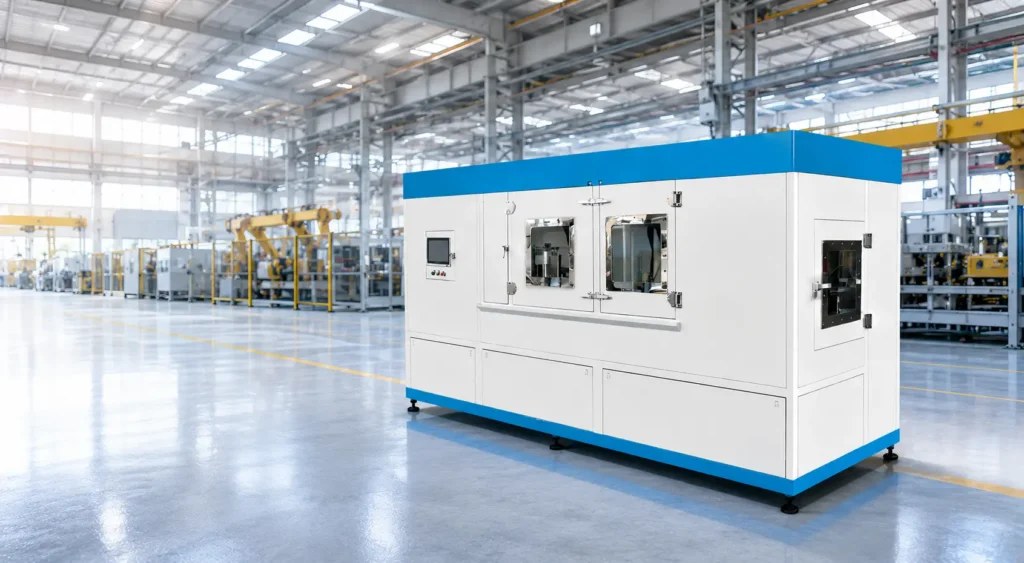
A laboratory wet blasting machine is a compact or semi-compact surface treatment system designed for process development, sample testing, pilot work, and low-volume precision finishing. Within the broader wet blasting family, it uses water to suspend abrasive particles in a slurry and then propels that slurry toward the part with compressed air. The laboratory format is defined less by a fixed size than by its function: it is built to let engineers tune blasting parameters with control and repeatability before they scale the process to production.
In industrial finishing terms, laboratory wet blasting sits between bench-scale experimentation and full-capacity production equipment. It is not merely a small cabinet. A well-designed lab system is expected to generate meaningful process data on abrasive behavior, surface finish, edge condition, removal rate, and fixture suitability. That makes it valuable in product development, quality engineering, and pre-purchase verification.
Wet blasting itself belongs to the abrasive surface treatment family described in [abrasive blasting terminology]. What distinguishes the wet version is the water phase, which changes how particles strike the workpiece. Compared with dry blasting, the slurry flow tends to reduce airborne dust, cushion abrasive impact, and support finer, more uniform finishes on many substrates.
For laboratory use, the strongest selling points are practical rather than dramatic. The first is low-dust process control, which improves visibility and housekeeping during repeated trials. The second is more stable treatment of delicate or high-value parts where dry abrasive impact could be too aggressive. The third is the ability to evaluate multiple abrasive grades and parameter recipes in a controlled environment before a factory commits to production tooling or automation.
A laboratory wet blasting machine can also be classified by how it presents the workpiece. Some systems are hand-loaded cabinets for flexible trials. Others incorporate rotary fixtures, servo axes, or robot-assisted manipulation for higher repeatability on complex samples. DassiAuto’s stated lineup includes an [RB-6 wet blasting R&D system] intended for laboratory and flexible process-development work, which is a useful example of how OEMs separate R&D equipment from batch-production machines.
Another key point is that laboratory equipment often carries a different economic purpose from production equipment. A production system is bought to maximize stable output. A laboratory wet blasting machine is bought to reduce uncertainty. It helps determine whether a burr can be removed without damaging a chamfer, whether a cutting edge can be honed to a target condition, whether a coating pretreatment window is consistent, or whether an additive-manufactured surface can be cleaned and smoothed without distorting critical features.
That is why the term “laboratory” should not be mistaken for “light duty” or “non-industrial.” In many factories, the lab machine is the first place where the real process is proved. If the trial stage is poorly controlled, scaling up becomes guesswork. If the lab stage is engineered properly, it becomes the foundation for repeatable production.
How Does laboratory wet blasting machine Work
A laboratory wet blasting machine works by circulating a water-abrasive slurry, accelerating that slurry with compressed air, directing it at the workpiece through a nozzle, and then recovering the spent slurry for reuse and waste separation. The basic physics are similar to larger wet blasting systems, but the laboratory format emphasizes flexibility, fast recipe changes, and close observation of process response.
Slurry Preparation and Suspension
The process begins in a slurry tank where water is mixed with abrasive media. The exact slurry concentration depends on the application, the abrasive type, and the target surface state. Finer concentrations may support delicate texturing or edge conditioning, while heavier abrasive loading may be used where stronger cutting action is needed.
Consistent suspension matters because settling changes the effective aggressiveness of the blast stream. A laboratory system therefore needs agitation, circulation, or pump design that keeps solids reasonably uniform during a test cycle. If concentration drifts too quickly, the test result becomes difficult to reproduce and even harder to scale.
Compressed Air Acceleration Path
The slurry is delivered to a blast gun or nozzle and combined with compressed air, which accelerates the abrasive particles toward the workpiece. The nozzle geometry, air pressure, slurry feed stability, stand-off distance, and impact angle all shape the final result. Even in lab-scale equipment, nozzle wear can gradually alter particle velocity and spray pattern, which is why a serious testing program tracks wear parts as part of process control.
In practical terms, the operator or control system adjusts pressure not to maximize force, but to tune the relationship between removal rate and surface integrity. For tool edge preparation, too much force may over-round the edge. For deburring, too little force may leave the burr intact. The laboratory machine allows those limits to be found without committing a production line to trial-and-error.
Workpiece Handling and Nozzle Motion
In the simplest configuration, the workpiece is manually positioned in the cabinet and exposed by an operator. More advanced laboratory wet blasting machines use indexing fixtures, turntables, servo slides, or robot-assisted handling so the nozzle path and exposure time can be repeated from part to part. That distinction matters because hand-guided testing is excellent for feasibility studies, but motion-controlled testing is better for generating scalable process data.
Complex geometries often benefit from programmable motion because surfaces, recesses, and edges do not respond equally to the blast stream. If the future production process will rely on automation, the laboratory stage should mimic that logic as closely as practical. Otherwise, the process may work in trials but fail when the part orientation changes in production.
Recovery, Sedimentation, and Mist Control
Once the slurry strikes the part, it drains back into the machine’s recovery loop. Reusable media recirculates, while fines, broken abrasive, and removed contaminants gradually separate through settling or other waste-management stages. This closed-loop slurry recovery is central to wet blasting economics and consistency, even on a laboratory machine.
Water suppresses dust, but it also introduces mist and suspended moisture inside the cabinet. Good laboratory equipment therefore uses extraction and mist-management features to preserve visibility, keep the interior cleaner, and reduce water carryover. These features matter more than many buyers expect because poor visibility makes precise testing slower and less repeatable.
PID Pressure Control and Recipe Stability
A laboratory wet blasting machine becomes more useful when it can hold the setpoint instead of merely approaching it. PID-based control helps stabilize slurry pressure and air delivery, which improves the repeatability of trials across different days or operators. That is particularly important when the machine is being used to qualify a process for later transfer into production.
Recipe management adds another layer of discipline. A stored recipe may include pressure, slurry concentration, blasting time, nozzle path, fixture type, and maintenance prompts. In a development setting, that makes it easier to compare trials and identify the variable that actually caused a finish change.
The true value of a laboratory wet blasting machine is its ability to convert surface-finishing trials into repeatable process knowledge.
| Process Parameter | Typical Range or Practice | Why It Matters |
|---|---|---|
| Working pressure | Typically low to moderate, adjusted by substrate and target finish | Governs impact energy, removal behavior, and edge conditioning |
| Slurry concentration | Maintained within a defined recipe band, often by wt% or volume ratio | Influences cutting action, finish stability, and consistency |
| Abrasive particle size | Fine to medium grades selected by application | Affects roughness, burr removal, and surface texture |
| Air flow demand | Sized to nozzle diameter, nozzle count, and duty cycle | Supports stable acceleration and avoids pressure drop |
| Media consumption rate | Depends on abrasive hardness, contamination, and recycle efficiency | Shapes operating cost and interval between slurry corrections |
| Control system | Commonly PLC/HMI with feedback control and recipe storage | Improves traceability, repeatability, and trial comparison |
laboratory wet blasting machine vs Dry Blasting vs Other Methods
A laboratory wet blasting machine is often evaluated against dry blasting, shot peening, and vibratory finishing because all four methods can alter a part surface, yet they do so for different reasons and with different levels of selectivity. For process-development work, the question is not which method is universally best, but which one offers the most useful control for the target result.
Dry blasting remains valuable where aggressive cleaning or roughening is needed and dust collection is already built into the plant. However, in a laboratory or R&D setting, dust control, cleanup time, and finish sensitivity can become limiting factors. Wet blasting reduces many of those burdens and often gives engineers a narrower, more tunable process window for fine finishing work.
Shot peening is another frequent comparison point, but it should not be confused with general abrasive finishing. Its primary purpose is to induce beneficial compressive residual stress, not to remove burrs or create a cosmetic matte surface. General background on this distinction is outlined in [shot peening process definitions]. Vibratory finishing, meanwhile, is effective for batch smoothing and edge softening, but it is less selective when only one feature or region needs treatment.
From a procurement standpoint, this comparison matters because a laboratory machine is usually purchased to answer process questions. If the problem is a fatigue-life requirement, shot peening may be the right test path. If the problem is controlled edge preparation, selective deburring, or cosmetic surface refinement with reduced dust, wet blasting often becomes the more suitable method.
| Evaluation Dimension | Laboratory Wet Blasting | Dry Blasting | Shot Peening | Vibratory Finishing |
|---|---|---|---|---|
| Airborne dust generation | Low because water suppresses suspended dust | High relative to wet blasting | Moderate, depending on media containment | Low external dust, but uses compounds and media systems |
| Surface finish control | High for matte, uniform, and delicate surface adjustment | Moderate to high, often more aggressive | Not primarily aimed at cosmetic finish control | Good for bulk smoothing, less selective |
| Media embedding risk | Reduced on many sensitive surfaces due to water film effect | Higher on some soft or coated materials | Depends on media and substrate pairing | Different mechanism; usually not evaluated this way |
| Feature selectivity | Strong with nozzle targeting and fixturing | Strong, but often more operator-dependent | Strong in defined peening zones | Weaker for local treatment of isolated features |
| Repeatability in trials | High when pressure and slurry are recipe-controlled | Variable if manual, better if automated | High in qualified peening programs | Moderate to high in steady batch conditions |
| Lab housekeeping | Favorable for enclosed test environments | Greater dust-management burden | Media handling still required | Compound cleanup and media separation required |
| Typical best use | Process development, deburring, edge prep, AM finishing | Heavy cleaning, roughening, rust removal | Fatigue-performance enhancement | Bulk edge softening and mass finishing |
Key Specifications to Evaluate Before Buying
Selecting a laboratory wet blasting machine starts with understanding whether the machine will be used for feasibility tests, customer samples, pilot production, or as a formal pre-production validation platform. The same cabinet size can behave very differently depending on whether it includes pressure feedback, stable slurry circulation, motion control, or a fixture concept that supports repeatable loading.
Laboratory Wet Blasting Pressure and Stability
The most important pressure question is not the maximum available setting but the stability of the chosen setpoint. For precision finishing, a drifting pressure signal can distort the entire trial result. Buyers should ask how the machine senses pressure, how it corrects deviations, and whether the displayed setpoint reflects actual blasting conditions rather than only supply pressure.
Slurry stability deserves equal attention. A machine with poor agitation or inconsistent return flow may show apparent success on a short trial but lose repeatability during longer runs. Engineers should ask how concentration is maintained, how contamination is removed, and how the operator knows when the slurry needs correction or replacement.
Motion Accuracy for Precision Surface Treatment
For hand-guided testing, flexibility is the main benefit. For process validation, repeatable positioning may be more important. Buyers should clarify whether the machine uses manual gun control, fixed nozzles, servo slides, rotary fixtures, or robot assistance, and whether these options match the likely production method.
DassiAuto’s company context states servo X/Y/Z linkage accuracy of 0.02 mm across its wet blasting lineup. In a laboratory environment, that level of control is most relevant where stand-off distance, path repeatability, or exposure dwell directly influence edge form, selective deburring, or finish uniformity. Buyers should also ask how axis accuracy relates to real process variation once nozzle wear and fixture tolerance are included.
Chamber Size, Visibility, and Throughput
Laboratory machines are often chosen for compactness, but the smallest cabinet is not always the most useful. Engineers need enough internal space for fixtures, line-of-sight inspection, safe glove access if applicable, and part rotation without blind zones. Visibility through the window and mist control are productivity issues because if the operator cannot see clearly, test quality falls.
Throughput should be evaluated realistically. A laboratory machine does not need mass-production output, but it should support enough parts per shift to complete validation work efficiently. If trials will involve design-of-experiment studies, quick cleaning and recipe changes may matter more than nominal cycle speed.
Controls, Waste Handling, and Utility Requirements
A modern HMI can add real value even on a small R&D system. Recipe storage, permission control, and alarm history make it easier for multiple engineers or technicians to reproduce the same conditions. This is especially useful when development work spans several weeks and several product variants.
Waste-sand handling also affects usability. Automatic sedimentation and straightforward discharge reduce maintenance effort and help prevent trial interruptions. Buyers should also confirm compressed-air demand, water management, electrical load, and any site requirements for drainage or mist extraction before comparing quotations.
Rather than focusing only on machine dimensions, procurement teams should review these practical checkpoints:
- Define whether the machine is for feasibility, sample approval, pilot production, or long-term lab use.
- Match chamber size to the largest true workpiece plus fixture clearance, not just nominal part dimensions.
- Verify how slurry concentration is measured, corrected, and documented.
- Ask how quickly the system can be cleaned when switching abrasives or materials.
- Check nozzle access, wear-part replacement, and operator visibility during blasting.
- Review whether the machine can store recipes for pressure, time, and motion settings.
- Confirm how waste sediment is removed and how often maintenance is typically required.
- Evaluate whether the control architecture can support later scale-up into a production process.
Applications Across Industries
A laboratory wet blasting machine is valuable precisely because it serves many industries before full production equipment is specified. It gives engineers a controlled space to answer material-specific questions, compare abrasive grades, refine edge conditions, and decide whether wet blasting should replace or complement an existing finishing method.
Tooling is one of the clearest examples. In carbide tool manufacturing, [edge honing of cutting tools] often requires controlled K-factor development rather than uncontrolled abrasive rounding. A laboratory machine allows the engineering team to compare media size, pressure, and dwell time before freezing the process for inserts, drills, or end mills.
Metalworking and precision machining create another large application area. For intersecting holes, fine burrs, and features that are difficult to finish manually, [burr removing of metal parts] can be evaluated first in the lab so the factory understands whether the method removes the burr without damaging adjacent surfaces. That is particularly helpful when parts are expensive, geometrically varied, or made from harder alloys.
Pretreatment applications also benefit from a laboratory stage. Before a coating line is changed, engineers may want to verify surface cleanliness, texture uniformity, or compatibility with downstream phosphating or painting. Wet blasting provides a way to test those effects in a more controlled environment than open dry abrasive cleaning.
Additive manufacturing, glass finishing, and 3C surface conditioning extend the application range further. In these segments, the target is often a specific tactile or visual surface state rather than bulk stock removal. The lab machine is useful because it lets engineers compare recipes on prototype or short-run parts without interrupting a production line.
| Application Type | Target Industry | Workpiece Example | Process Benefit |
|---|---|---|---|
| Edge honing | Carbide cutting tools | Inserts, drills, end mills | Controlled edge preparation and better edge consistency |
| Burr removal | Precision machining and stamping | Small machined or stamped metal parts | Selective deburring with reduced manual variation |
| Scale removal | Forging and steel processing | Steel bars, forgings, heat-treated components | Oxide cleaning with more even surface condition |
| Pretreatment before coating | Automotive, hardware, appliances | Brackets, housings, fabricated parts | Cleaner substrate and more stable coating adhesion |
| AM post-processing | Additive manufacturing | 3D-printed metal components | Surface smoothing and residue removal on complex shapes |
| Light peening / surface conditioning | General engineering | Functional metal parts | Controlled surface effect where gentler impact is preferred |
| Glass frosting | Glass processing | Decorative or functional glass pieces | Uniform matte appearance with reduced dust burden |
| 3C device finishing | Electronics supply chain | Casings, shells, frames | Fine texture control and cosmetic consistency |
Equipment Selection Guide
A laboratory wet blasting machine should not be selected in isolation from the broader equipment roadmap. Many factories begin with R&D trials, then move to batch cabinets, then add dedicated automation only after the process window is proven. For that reason, the best machine choice is often the one that supports both present testing and future scale-up logic.
Matching Lab Equipment to Production Intent
If the current need is only occasional sample work, a simple flexible cell may be enough. If the machine will function as the plant’s formal process-development platform, it may need stronger control architecture, fixture repeatability, and traceable recipes from the start. Buyers should therefore ask whether the lab machine is a temporary tool or a permanent engineering asset.
When to Move Beyond a Laboratory Wet Blasting Machine
Once part families stabilize and cycle-time pressure rises, dedicated production systems usually become more economical. A standard batch cabinet can take over routine work that no longer needs experimental flexibility. High-throughput or geometry-specific lines then handle mature products more efficiently than a lab unit ever could.
The advantage of an OEM with multiple architectures is that process data from the lab can be transferred logically into the next machine class. That reduces the risk of proving the process in one environment and then losing the result in scale-up.
| Configuration / Model Tier | Target Production Scale | Workpiece Size Range | Precision Level | Recommended Applications |
|---|---|---|---|---|
| 1. Laboratory R&D cell | Process development and trial work | Small precision parts | Very high flexibility | Sample testing, DOE studies, recipe creation |
| 2. Compact manual cabinet | Low-volume technical work | Small parts | Moderate to high | Feasibility checks, repair work, flexible finishing |
| 3. Standard batch cabinet | Small to medium batch production | Small to medium parts | High | Deburring, cosmetic finishing, validated batch processes |
| 4. Single-piece dedicated system | Stable individual-part processing | Medium to large single parts | High | Repeat treatment of one part per cycle |
| 5. Servo multi-axis system | Precision engineered components | Small to medium complex parts | Very high | Complex geometry, selective blasting, edge control |
| 6. Plate-part system | Repetitive flat components | Plate-shaped and flat parts | High | Surface conditioning of sheets and flat profiles |
| 7. Double-chamber system | Higher-volume production | Small to medium repeat parts | High | Continuous batch flow with reduced idle loading time |
| 8. Inline integrated cell | Automated production lines | Application-specific | High and traceable | Coating pretreatment and linked finishing operations |
A practical selection path often begins with the laboratory tier even if the final destination is a production line. The lab stage defines abrasive type, pressure band, path strategy, and expected finish behavior. Once those variables are stable, the engineering team can decide whether the process belongs in a standard cabinet, a dedicated single-part machine, or a more automated system.
Cost, Lead Time and ROI Considerations
The cost of a laboratory wet blasting machine depends less on chamber size alone than on the sophistication of the control and handling package. A basic R&D cabinet with manual operation will generally cost less than a machine with servo axes, programmable recipes, advanced mist control, custom fixtures, and validated sample-processing support. That difference is justified when the machine is expected to generate repeatable development data rather than only casual one-off tests.
Price is also influenced by how many process variables the buyer expects the equipment to manage automatically. Machines with better slurry circulation, pressure feedback, recipe management, and cleaner waste handling can reduce operator dependence, but they also involve more engineering content. For technical users, that is often a productive trade-off because the purpose of a lab machine is to separate real process effects from operator inconsistency.
Lead time is best discussed in typical bands rather than fixed promises. Standard laboratory units tend to move faster because the core mechanical platform is already defined. Lead time expands when the buyer requests custom fixtures, nonstandard controls, multi-axis motion, export-specific electrical packages, or trial processing before final design freeze.
ROI for a laboratory wet blasting machine should be framed differently from ROI for a production line. The return usually comes from avoided mistakes rather than direct labor elimination. A good lab machine reduces the risk of specifying the wrong abrasive, overbuilding production equipment, approving a poor surface-treatment route, or discovering too late that the finish damages tool edges or downstream coating performance.
There are still direct financial effects. Manual finishing trials become more disciplined, sample approval cycles can shorten, and the engineering team can compare multiple process windows in one controlled station. In tooling, the gain may appear as more stable edge preparation. In deburring, it may appear as lower scrap or fewer secondary touch-ups. In pretreatment, it may appear as fewer coating failures once production begins.
For many plants, the best ROI calculation asks three questions. First, how much engineering uncertainty does the machine remove? Second, how much rework or false-start cost can be avoided during process launch? Third, how effectively can laboratory data be transferred into a production method without starting over? If those answers are strong, even a modest-capacity machine can justify itself quickly.
Why Choose DassiAuto — Our Company
DassiAuto Intelligent Equipment Co., Ltd is a Chinese manufacturer established in 2012 and focused on wet blasting technology for industrial surface treatment. According to the company background presented at [about DassiAuto], it operates as a national high-tech enterprise and under ISO 9001 quality management, consistent with the broader [ISO 9001 quality management standard]. The company context states that it holds invention patents, utility model patents, and software copyrights related to blasting equipment and control systems.
Within the wet blasting equipment range, the stated engineering features include PID closed-loop pressure control, servo X/Y/Z linkage with 0.02 mm control accuracy, HMI recipe management with hierarchical permissions, automatic waste-sand sedimentation with one-click discharge, and dust-collection systems that reduce water mist. The same company context describes eight equipment configurations covering R&D, batch production, and application-specific requirements, along with four matched TR-series abrasive grades selected according to material type, geometry, particle size, hardness, and cost objectives.
The published application scope includes edge honing of cutting tools, selective deburring of metal parts, scale removal of steel bars and forgings, pretreatment before coating, post-processing of additive-manufactured parts, peening of metal parts, frosting of glass, and finishing of 3C device surfaces. Named customer references in the supplied context include Wecan Cutting Tools, Ruian Carbide Tools, Huareal, Metcera, OKE, YG, Kelite, and XTC. The same source describes a full-cycle service model covering sample testing and application development, planning and design, manufacturing and quality control, installation and commissioning, training, and after-sales support including spare parts, consumables, and process optimization.
FAQ
Q1. Is a laboratory wet blasting machine only for R&D, or can it also handle small production batches?
It can do both, depending on configuration and cycle-time expectations. Many laboratory systems are used first for sample testing and later for pilot runs, customer approvals, or specialty low-volume production. The key limitation is usually throughput, not process capability.
Q2. What information should buyers prepare before requesting a quotation?
Buyers should provide part material, dimensions, target surface result, current process, annual or monthly volume, and any restrictions on geometry or masking. Photos, drawings, and sample parts are especially useful because wet blasting performance depends strongly on the interaction between part shape and nozzle exposure. This information helps the OEM define whether a true laboratory system is sufficient or whether a batch machine is the better fit.
Q3. Can the supplier run sample testing before the final machine design is confirmed?
Yes, and that step is often essential for laboratory wet blasting projects. Sample testing helps establish abrasive type, pressure band, exposure time, and whether the required finish or deburring result is realistically achievable. It also reduces the risk of buying a machine configuration that does not match the actual process window.
Q4. How long does installation and commissioning usually take for a laboratory wet blasting machine?
It depends on whether the machine is standard or customized and whether site utilities are ready. A simpler laboratory cabinet usually installs faster than a machine with servo motion, custom fixtures, or advanced controls. Commissioning should include not only startup, but also recipe confirmation and operator handover on representative parts.
Q5. What spare parts and consumables should be planned from the beginning?
Most buyers should plan for nozzles, seals, hoses, viewing-window protection items, and any pump or slurry-delivery wear components, along with the selected abrasive media. Maintenance planning should also cover sediment removal and routine cleaning when switching between materials or media grades. A laboratory machine is a process tool, so consumable discipline directly affects repeatability.
Q6. How should warranty and after-sales support be evaluated for this type of equipment?
The most useful approach is to look beyond the formal warranty period and assess the supplier’s ability to support process stability over time. Buyers should ask whether support covers remote troubleshooting, spare parts, abrasive resupply, recipe optimization, and operator retraining if the application changes. For a laboratory wet blasting machine, after-sales quality matters because the machine is often used to make decisions that shape later production investment.